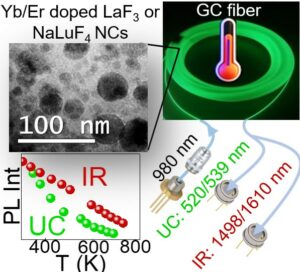
 Oxyfluoride glass-ceramics (GCs) containing LaF3 or α-NaLuF4 nanocrystals, co-doped with 2 mol% Yb3+ and 0.5 mol% Er3+, are considered as core materials for the implementation of optical fiber photoluminescence (PL) thermometers. A dual-channel ratiometric thermometry approach combining green (UC, 2H11/2 → 4I15/2 vs 4S3/2 → 4I15/2) and infrared emissions (IR, 4I13/2(m´) → 4I15/2 vs 4I13/2(m) → 4I15/2) allows the extension of the sensing temperature range above the UC luminescence quenching (at ≈ 650 K) by over 100 K (LaF3) or 150 K (α-NaLuF4). The IR channel, working near λ= 1.55 mm, operates at the wavelength of minimum propagation losses of optical fibers, facilitating long-distance propagation of luminescence signals. The UC channel in LaF3-GC shows a maximum absolute sensitivity SA = 102 × 10-4 K-1 at 602 K in glass and SA = 71 × 10-4 K-1 at 591 K in GC with thermal resolution δ = 1.5–3 K. The α-NaLuF4-glass and -GC reach UC SA = 90 × 10-4 K-1 at 698 K. The IR channel in both GCs, based on PL intensity ratios at 1498 nm and 1610 nm, exhibits SA ≈ 30-10 × 10-4 K-1 for the 300-800 K range.
Published in Advanced Optical Materials vol 14, pg e01720, 2026