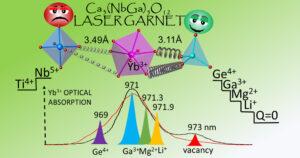

 The cationic charge increase on the tetrahedral garnet site shifts the ytterbium level energy towards higher values.
Crystallographic information on the cationic interactions that may broaden the Yb3+ optical bands in garnets for sustaining shorter femtosecond laser pulses is provided. It is shown that the energy of the Yb3+ 2F7/2(0)↔2F5/2(0´) optical absorption (0↔0´ OA) measured at a cryogenic temperature (T= 6 K) in Ca3(NbGa□)5O12 (CNGG) type disordered single crystal garnets is sensitive to the electric charge of cations incorporated in the 24d tetrahedral site while very little sensitive to the substitutions made on the 16a octahedral one.
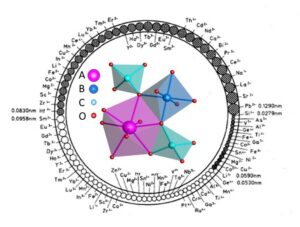
Li+ and Ge4+ fill exclusively tetrahedral garnet site with a strong reduction of the cationic vacancy density monitored in the Li case by positron annihilation lifetime spectroscopy (PALS). Ti4+ sits exclusively in the octahedral garnet site with no effect on the crystal cationic vacancy density, while Mg2+ is distributed in the three garnet sites with preference for the tetrahedral one and a moderate reduction of the crystal vacancy density.
Yb3+ 0↔0´ OA bands observed at λ = 973 nm, 971.9 nm, 971.3 nm, 971.1 nm and 969.6 nm are correlated with the presence in the nearest to Yb3+ tetrahedral garnet sites of a vacancy (electric charge Q=0), Li+, Mg2+, Ga3+ and Ge4+, respectively. However, the incorporation of Ti4+ in the octahedral site substituting mainly Ga3+ has not observable effect on the Yb3+ 0↔0´ OA.