

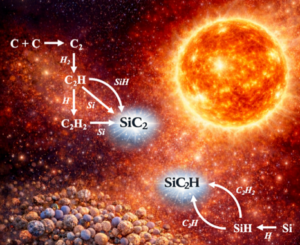
 In this work, we investigate the formation mechanisms of silicon carbide cosmic dust under conditions mimicking the atmospheres of evolved carbon-rich stars. By combining ultra-high vacuum experiments, advanced spectroscopy and microscopy techniques, and theoretical modelling, we demonstrate the key role played by molecular hydrogen in triggering the chemical pathways that lead from atomic carbon and silicon to SiC nanodust formation. In particular, we identify SiC2 as a crucial molecular precursor in the growth process. The experiments reveal the formation of partially hydrogenated silicon carbide nanograins together with a rich family of organosilicon species. In addition, thermochemical calculations and chemical kinetics simulations provide insight into the underlying reaction network governing the transition from simple atoms and molecules to complex dust grains. These findings contribute to a deeper understanding of dust formation processes in circumstellar environments and the chemical evolution of the universe.
This work has been published in:
“The important role of hydrogen in the formation of silicon carbide in evolved stars”, G. Tajuelo-Castilla, G. Santoro, L. Martínez, P. Merino, J. I. Martinez, P. L. de Andres, G. J. Ellis, Á. Mayoral, R. J. Peláez, I. Tanarro, M. Agúndez, S. Wiersma, H. Sabbah, J. Cernicharo, C. Joblin, J. A. Martin-Gago, Nature Astronomy (2026), DOI: 10.1038/s41550-026-02854-1”