

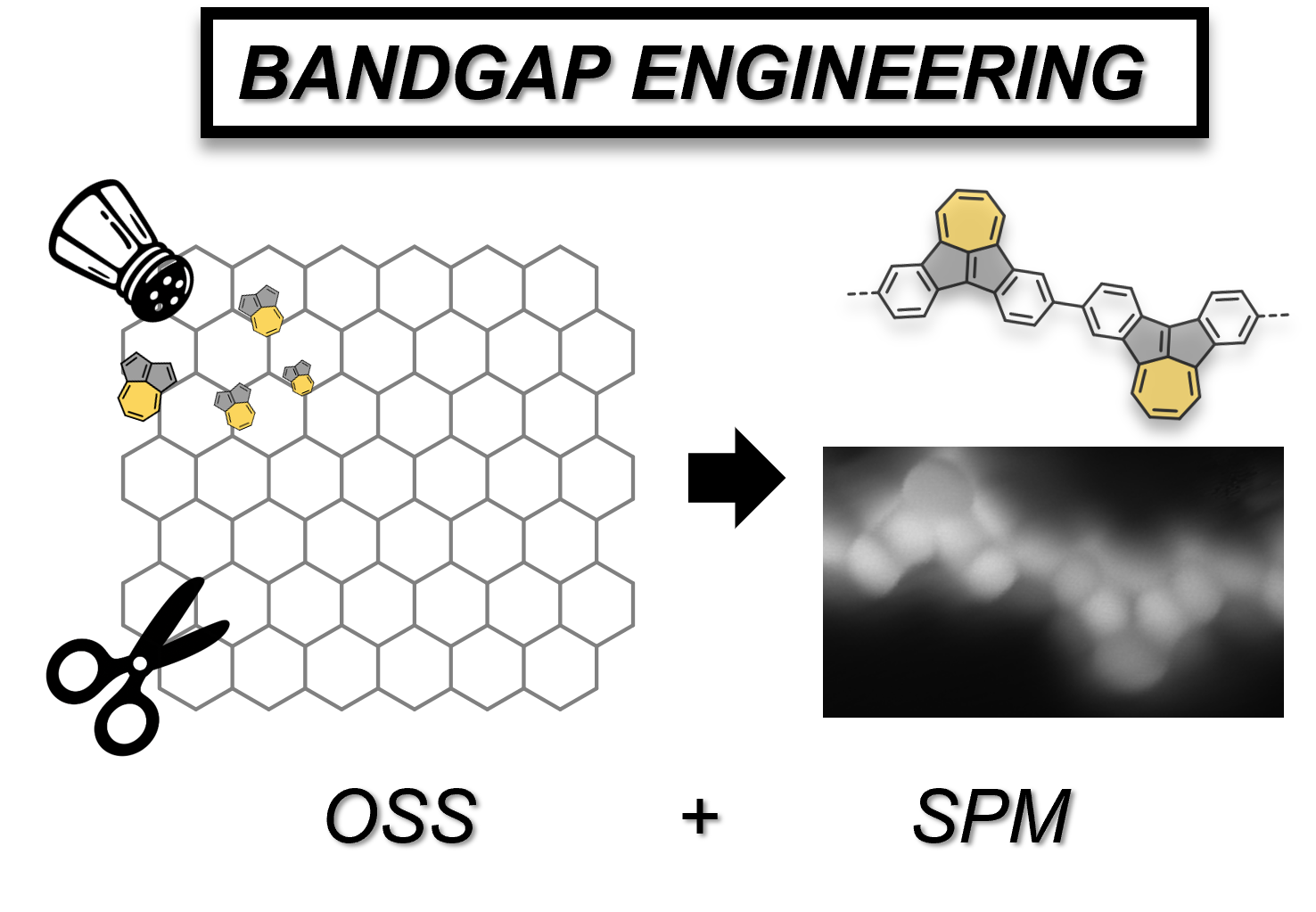
Introducing nonhexagonal rings into π-conjugated frameworks provides a
means of controlling the electronic structure of low-dimensional carbon
materials. We use thermally activated Ullmann coupling on Au(111) to
prepare a nonalternant polymer containing cyclopenta[c,d]azulene (CPA)
units. Bond-resolved scanning tunneling microscopy shows that the fused
[7–5–5] ring system remains intact upon polymerization.Scanning
tunneling spectra and spatially resolved dI/dV maps, interpreted with
the aid of density functional theory calculations, establish a band gap
of 1.5 eV. Charge redistribution from the seven-membered ring toward the
two fused five-membered rings dominates the electronic structure and
gives rise to a substantial dipole moment in this all-hydrocarbon
system. Aromaticity analysis identifies both locally aromatic and weakly
antiaromatic regions, reflecting the electronic frustration imposed by
the nonalternant ring arrangement. These results establish the CPA unit
as a building block for tuning the band gaps of surface-grown carbon
polymers.
The results of this work have been published in the Journal of the American Chemical Society (JACS):