

The Low‑Dimensional Materials research line within the ESISNA group focuses on the fundamental study of two‑dimensional (2D) materials, such as graphene, and the translation of this knowledge into advanced nanoscience and nanotechnology applications.
This research is built on a comprehensive and integrated approach that covers the entire technological cycle, from atomic‑scale physicochemical investigations to the development and implementation of next‑generation sensing technologies. The goal is to bridge fundamental science and real‑world applications, enabling the creation of innovative Poin-of-Care devices with impact in areas such as biosensing, diagnostics, and nanotechnology. Accordingly, this research line is organized into two complementary sublines, each addressing different aspects of the scientific and technological development:
1. Fundamentals of Low‑Dimensional Materials
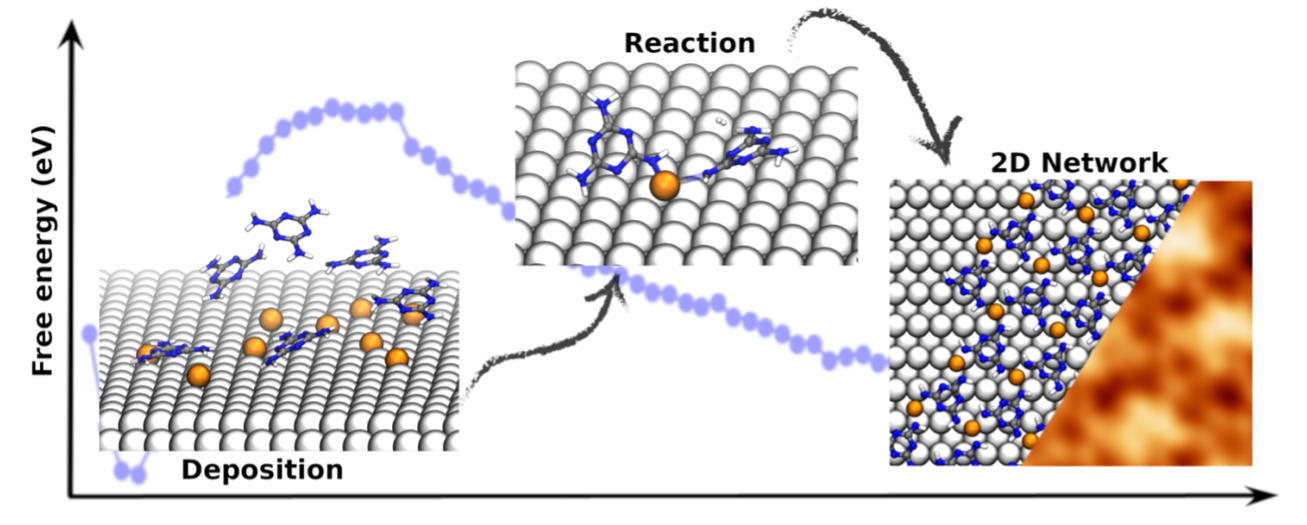
This subline focuses on the atomic‑scale study and synthesis of two‑dimensional (2D) materials, including graphene, as well as the controlled fabrication and characterization of complex nanostructures and 2D networks.
The research addresses fundamental questions in surface physical chemistry at the atomic level, while also exploring the tailoring of electronic and structural properties. These efforts aim to optimize materials for specific functional applications.
2. Graphene‑Based Sensing Technologies
This subline focuses on the translation of surface science into practical sensing technologies, bridging fundamental research with biotechnology. The main goal is the functionalization of graphene and other 2D materials to develop high‑performance, ultrasensitive detection platforms.
Current research is primarily directed toward the detection of pathogens such as HCV and HIV, while progressively expanding to other diseases as well as environmental contaminants. This work is carried out in close collaboration with hospitals (Hospital Ramón y Cajal) and industrial partners (Attenbio), ensuring strong clinical and translational relevance.
In addition, this subline includes a significant technological development component, covering both hardware and software, aimed at the creation of Point‑of‑Care (PoC) diagnostic devices. Through this approach, the research actively contributes to bringing graphene‑based sensing technologies from the laboratory into real‑world applications.

Software – SenCapp (Sensing Curve Analysis and Processing Programme)
Authors: F. Velasco, A. Jiménez, J. Azpeitia and I. Palacio
AGPL-3.0
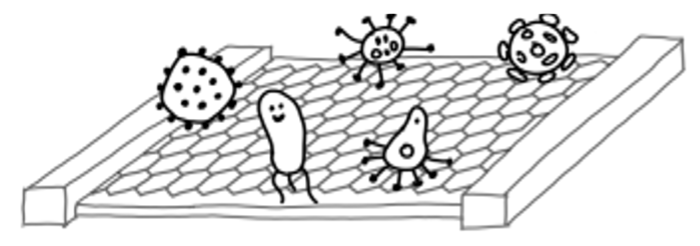
SenCapp is a fully automated Python‑based software designed for the analysis and visualization of electrical sensing and biosensing data. It enables the characterization of device response to varying analyte concentrations, either at the level of individual transistors or across entire multi‑transistor devices, while requiring only a minimal set of input parameters.
The software streamlines the analysis workflow by simultaneously processing and comparing transfer curves, extracting relevant variables, and generating clear, informative visualizations. This integrated approach allows for a fast, comprehensive, and compact analysis of datasets containing multiple transistors.
By eliminating the need for separate, manual analyses for each device or measurement type, SenCapp significantly reduces characterization time and increases efficiency compared to traditional, non‑integrated methods. As a result, it provides a powerful tool for accelerating the development and evaluation of advanced sensing platforms.
Collaboration with companies
Attenbio
R&D Contract for the Functionalization of Graphene-Based Biosensors.

Responsible Scientist: Irene Palacio
Key Publications:
-
- S. Jiménez-Fernández, E. Tosi, J. I. Martínez, V. Villalobos-Vilda et al. Hydrogen-driven transition from a 2D-metal monochalchogenide to a surface alloy. Surfaces and Interfaces, 80, 108321 (2026)
- J. M. Zamalloa-Serrano, J.I. Mendieta-Moreno, J. M. Gómez-Fernández et al. Single-metal-adatom catalysts for the synthesis of 2D carbon nitride metal-coordinated networks. Carbon, 29, 119544 (2024)
- S. K. Beura, A. R. Panigrahi, P. Yadav et al. Harnessing Two-Dimensional Nanomaterials for Diagnosis and Therapy in Neurodegenerative Diseases: Advances, Challenges and Prospects. Ageing Research Reviews, 94, 102205 (2024)
- R. Muñoz, L. León-Boiges, E. López-Elvira et al. Acrylates Polymerization on Covalent Plasma-Assisted Functionalized Graphene: A Route to Synthesize Hybrid Functional Materials. ACS Appl. Mater. Interfaces, 15, 46171 (2023)
- I. Palacio, M. Moreno, A. Náñez, A. Purwidyantri, T. Domingues, P. D. Cabral, J. Borme, M. Marziello, J. I. Mendieta-Moreno, B. Torres-Vázquez, J. I. Martínez, M. F. López, M. García-Hernández, L. Vázquez, P. Jelinek, P. Alpuim, C. Briones, J. A. Martín-Gago. Attomolar detection of hepatitis C virus core protein powered by molecular antenna-like effect in a graphene field-effect aptasensor. Biosens. Bioelectron., 222, 115006 (2023)
- J. Azpeitia, P. Merino, S. Ruiz-Gómez, M. Foerster, L. Ablle, M. García-Hernández, J. A. Martín-Gago and I. Palacio. LiCl Photodissociation on Graphene: a Photochemical approach to Lithium Intercalation. ACS Applied Materials & Interfaces, 13, 42205 (2021).
- Backes et al. Production and processing of graphene and related materials. Topical Review. 2D Materials, 7, 022001 (2020)
- I. Palacio, L. Aballe, M. Foerster, D. G de Oteyza, M. García-Hernández and J.A. Martin-Gago. Reversible Graphene decoupling by NaCl photo-dissociation. 2D Materials, 6, 025021 (2019)
- I. Palacio, G. Otero-Irurueta, C. Alonso, J. I. Martínez, E. López-Elvira, I. Muñoz-Ochando, H. J. Salavagione, M. F. López, Mar García-Hernández, J. Méndez, G. J. Ellis and J. A. Martín-Gago. Chemistry below graphene: Decoupling epitaxial graphene from metals by potential-controlled electrochemical oxidation. Carbon, 129, 837 – 846 (2018)
- Azpeitia J.; Otero-Irurueta G.; Palacio I. ; Martinez J. I.; Ruiz del Árbol N.; Santoro G.; Gutiérrez A.; Aballe L.; Foerster M.; Kalbac M.; Vales V.; Mompeán F. J.; García-Hernández M.; Martín-Gago J. A.; Munuera C. ; López M. F. High-quality PVD graphene growth by fullerene decomposition on Cu foils. Carbon 119, (2017), 535–543.
- Bueno, J.I. Martinez, R. Luccas, N. Ruiz del Arbol, C. Munuera, I. Palacio, F. Palomares, K. Lauwaet, S. Thakur, J.M. Baranowski, W. Strupinski, M.F. Lopez, F. Mompean, M. Garcia-Hernandez, and J.A. Martin-Gago. Highly selective covalent organic functionalization of epitaxial graphene. Nat. Comm. 8, 15306 (2017).
- R. Bueno, M. Marciello, M. Moreno, C. Sánchez-Sánchez, J.I. Martinez, L. Martinez, E. Prats-Alfonso, A. Guimerà-Brunet, J.A. Garrido, R. Villa, F. Mompean, M. García-Hernandez, Y. Huttel, M. del Puerto Morales, C. Briones, M.F. López, G.J. Ellis, L. Vázquez, J.A. Martín-Gago. Versatile Graphene-Based Platform for Robust Nanobiohybrid Interfaces. ACS Omega 4, (2019) 3287.