New article of the group

NanoResearch

Stepwise magnetization reversal of geometrically tuned in diameter Ni and FeCo bi-segmented nanowire arrays

Ester M. Palmero, Miguel Méndez, Silvia González, Cristina Bran, Víctor Vega, Manuel Vázquez and Víctor M. Prida

https://doi.org/10.1007/s12274-019-2385-9

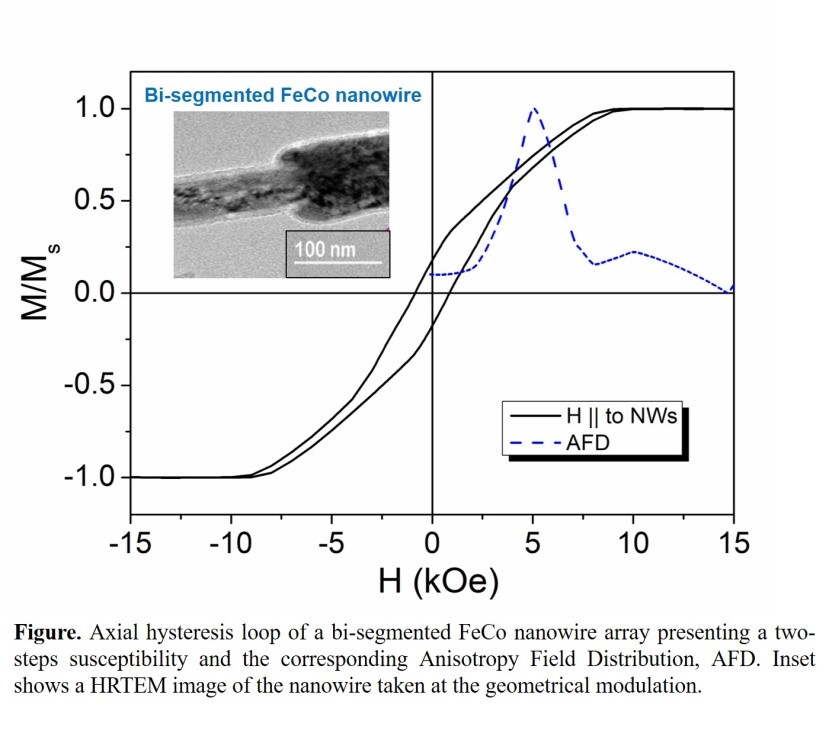
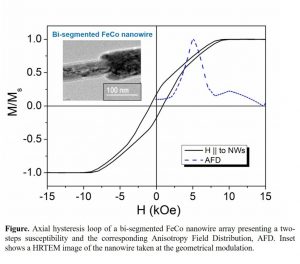
The magnetization process of hexagonal dense arrays of bi-segmented Ni and FeCo nanowires consisting of two well defined diameters (45 and 80 nm) are reported. The nanowires were grown inside of tailored pores of anodic alumina templates by combined anodization, atomic layer deposition (ALD) and electrodeposition. The results clearly enable to identify a two-step process ascribed to the respective segments of different diameter, as concluded from the differential susceptibility of the loops, and confirmed by the first-order reversal curve (FORC) distribution diagrams, where an elongation parallel to the interaction axis around two coercive field values is obtained. This well-defined two-step magnetization reversal process through the nanowire diameter design represents a promising route for the advanced control of the remagnetization in arrays of magnetic multidomain systems.
This study performed in collaboration with the University of Oviedo has been supported by the Spanish Ministerio de Economia y Competitividad (MINECO) under the coordinated research Projects MAT2013-48054-C2 and MAT2016-76824-C3.


 

New people in the group

Soledad Aprea, PhD student from the National University of Cordoba (Argentina) is incorporated to the group until September 15th to work on “Magnetic Nanowires” under the supervision of Cristina Bran and Manuel Vazquez in the framework of the i- COOPB203017 project with that University funded by CSIC.

New article of the group

AIP Advances 9, 035114, 2019

Consequences of aging on ferromagnetic amorphous Fe75Si10B15 microwires for advanced inductive applications

X. Zhang, R. P. del Real, M. Vázquez and L. H. Lewis

doi.org/10.1063/1.5080098

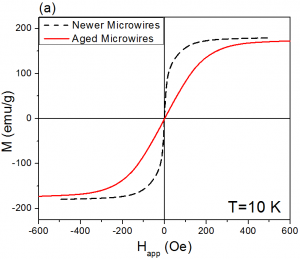
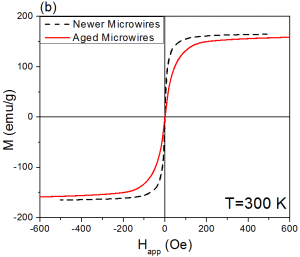
Amorphous ferromagnetic microwires fabricated by in-water-quenching are assessed to show favorable properties as compared to those in sheet or ribbon form. In-water-quenched amorphous Fe75Si10B15 microwires prepared at ICMM/CSIC were subjected to aging up to 5 years time in air at room temperature. While both newer and aged microwires are X-ray amorphous, the aged ones exhibit a slight crystallinity degree, a lower initial susceptibility and a reduced enthalpy change for full devitrification. Such small differences (typically < 5%) are attributed to minor surface oxidation whose stress couples to magnetostriction to promote the formation of radial domains. This study demonstrates that amorphous microwires are essentially stable against aging in the air, a key point for advanced applications for next-generation high-frequency electric machines.


This article derives from the 2017 Sabbatical visit at the ICMM/CSIC of Prof. Laura H. Lewis from Northeastern University, Boston, funded by the National Science Foundation, U.S.A.

New people in the group

Guillermo Lopez-Polin obtained a Juan de la Cierva fellowship and
joined the group on April of 2019 under the supervision of Agustina
Asenjo. His project is about tuning the magnetic properties of 2D
materials with strain. He will be in the group until March of 2021.