New paper of the group

Extraordinary Chiral Exchange-Bias Phenomenon: Engineering the Sign of the Bias Field in Orthogonal Bilayers by a Magnetically Switchable Response Mechanism

Alberto Bollero, Volker Neu, Vincent Baltz, David Serantes, José Luis F. Cuñado, Javier Pedrosa, Ester M. Palmero, Marietta Seifert, Bernard Dieny, Rafael P. del Real, Manuel Vázquez, Oksana Chubykalo-Fesenko and Julio Camarero

Nanoscale, 2020

DOI: 10.1039/C9NR08852K

Isothermal tuning of magnitude and sign of the bias field has been achieved by exploiting a new phenomenon in a system consisting of two orthogonally coupled films: SmCo5 (out-of-plane anisotropy)-CoFeB (in-plane anisotropy). This has been managed by using the large dipolar magnetic field of the SmCo5 layer resulting in pinning one branch of the loop (either ascending or descending branch) at a fixed field value while the second one is modulated along the field axis by varying the orientation of an applied magnetic field. This enables the control of the sign of the bias field in a novel manner. Moreover, modulation of the bias field strength is possible by varying the thickness of a spacer between the SmCo5 and CoFeB layers. This study shows that the observed phenomena find their origin in the competition of artificially induced anisotropies on both layers, resulting in a reversible chiral bias effect that allows selecting the initial sign of the bias field by switching (upwards/downwards) the magnetization in the SmCo5 film.


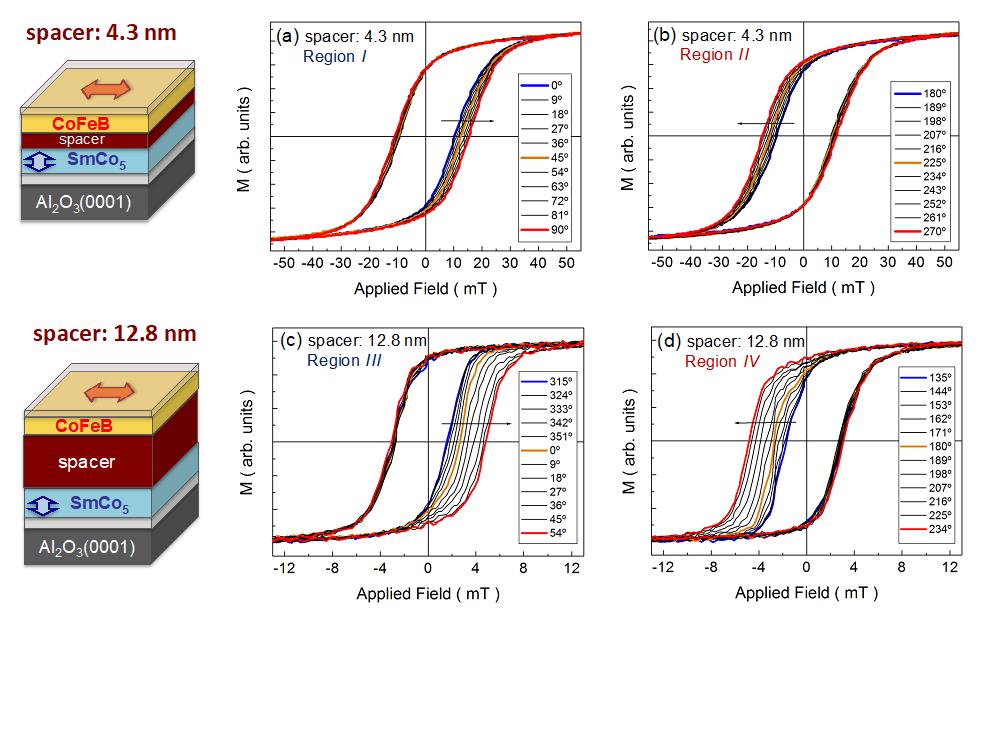
The figure shows the in-plane hysteresis loops measured by MOKE with magnetic field applied at different in-plane angles for: (a) and (b) SmCo5(30nm)/spacer(4.3nm)/CoFeB(3nm); and (c) and (d) SmCo5(30nm)/spacer(12.8nm)/CoFeB(3nm). aH = 0° corresponds to applied magnetic field parallel to the easy axis direction of the Si/SiO2/CoFeB reference sample. Arrows are visual guides to show the continuous increase in coercivity when varying the field while keeping pinned one of the loop branches.


This work, in collaboration with IMDEA Nanoscience, Madrid; IFW Dresden; SPINTEC, Univ. Grenoble Alpes/CNRS/CEA and the Univ. Autónoma de Madrid, has been supported partly by the Spanish Ministry of Economy, Industry and Competitiveness (MINECO) under project MAT2016-76824-C3-1-R and by the Regional Government of Madrid under project S2018/NMT-4321 NANOMAGCOST-CM. 
 

New paper of the group

«Exotic Transverse-Vortex Magnetic Configurations in CoNi Nanowires»

Ingrid Marie Andersen, Luis Alfredo Rodríguez, Cristina Bran, Cécile Marcelot, Sébastien Joulie, Teresa Hungria, Manuel Vázquez, Christophe Gatel and Etienne Snoeck

ACS Nano, December 11, 2019

DOI: https://doi.org/10.1021/acsnano.9b07448


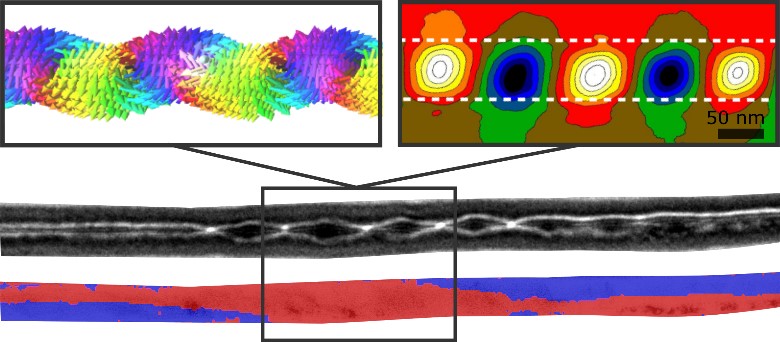
The magnetic configurations of cylindrical Co-rich CoNi nanowires have been quantitatively analyzed at the nanoscale by electron holography and correlated to local structural and chemical properties. The nanowires display grains of both face-centered cubic (fcc) and hexagonal close-packed (hcp) crystal structures, with grain boundaries parallel to the nanowire axis direction. Electron holography evidences the existence of a complex exotic magnetic configuration characterized by two distinctly different types of magnetic configurations within a single nanowire: an array of periodical vortices separating small transverse domains in hcp rich regions with perpendicular easy axis orientation, and a mostly axial configuration parallel to the nanowire axis in regions with fcc grains. These vastly different domains are found to be caused by local variations in the chemical composition modifying the crystalline orientation and/or structure, which give rise to change in magnetic anisotropies. Micromagnetic simulations, including the structural properties that have been experimentally determined, allows for a deeper understanding of the complex magnetic states observed by electron holography.

This work derives from the current collaboration between our GNMP group and CEMES – CNRS, Toulouse, France. It has been partly supported by the Spanish Ministry of Economy, Industry and Competitiveness (MINECO) under project MAT2016-76824-C3-1-R and by the Regional Government of Madrid under project S2018/NMT-4321 NANOMAGCOST-CM

New book


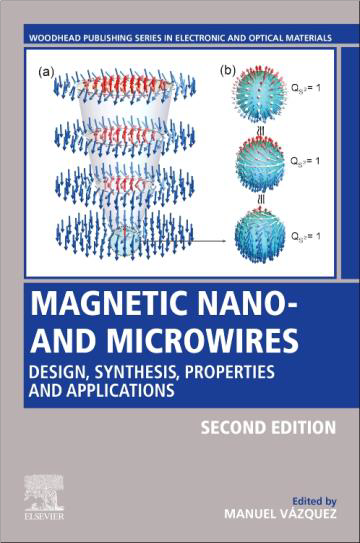
«Magnetic Nano- and Microwires: Design, Synthesis, Properties and Applications»

2nd Edition, edited by Manuel Vázquez

ISBN: 9780081028322 (Woodhead Publishing, Elsevier) (2020), pp. 962

A Volume in the Woodhead Publishing Series in Electronic and Optical Materials. The most comprehensive reference available on magnetic nanowires and microwires.

Flyer of the Book

KEY FEATURES

  • Details the multiple key techniques for the growth, processing and characterization of nanowires and microwires
  • Discusses magnetism and transport in nanowires, skyrmions and domain walls in nano and microwires and the latest innovations in magnetic imaging
  • Reviews the principles and difficulties involved in applying magnetic nano- and microwires to a wide range of technologies, including biomedical and sensing applications

DESCRIPTION

Magnetic Nano-and Microwires: Design, Synthesis, Properties and Applications, Second Edition, reviews the growth and processing of nanowires and nanowire heterostructures using such methods as electrodeposition and sol-gel, focused-electron/ion-beam-induced deposition, epitaxial growth by chemical vapor transport, and ultrafast solidification. Other sections cover engineering nanoporous anodic alumina, discuss magnetic and transport properties, domains, domain walls in nano-and microwires, and provide updates on skyrmions, domain walls, magnetism and transport, and the latest techniques to characterize and analyze these effects.

Final sections cover applications, both current and emerging, and new chapters on memory, sensor, thermoelectric and nanorobotics applications. This book will be an ideal resource for academics and industry professionals working in the disciplines of materials science, physics, chemistry, electrical and electronic engineering and nanoscience.