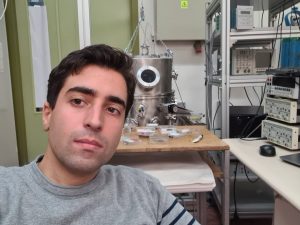
Felipe Tejo, from Chile, has been awarded with a postdoc grant «ANID-PFCHA/Postdoctorado Becas Chile 74200122» and he will be with us until June 2022. Using magnetic simulations he will study magnetic properties of skyrmions and Bloch points.


Group of Nanomagnetism and Magnetization Processes
Instituto de Ciencia de Materiales de Madrid, CSIC

Felipe Tejo, from Chile, has been awarded with a postdoc grant «ANID-PFCHA/Postdoctorado Becas Chile 74200122» and he will be with us until June 2022. Using magnetic simulations he will study magnetic properties of skyrmions and Bloch points.

Cantia Belloso Casuso has been awarded with a FPU contract. In her PhD (Magnetic nanoelements for emerging tecnologies in energetic use), under the supervision of Agustina Asenjo, she will fabricate and characterize (by MFM and other techniques like AFM, VSM or MOKE) thermomagnetic devices based on planar and cylindrical structures.

Paul-Iulian Gavriloaea will make his PhD (Large-scale modelling of combined all-optical and/or electric switching) with us under the supervision of Oksana Fesenko. The PhD project is part of the Marie Skłodowska-Curie Action COMRAD (Cold Opto-Magnetism for Random Access Devices). The key aim of the consortium is to combine spin-orbitronics with ultrafast magnetism towards the development of faster (sub 100 ps) and greener (< 10 fJ/bit) random access devices. In general lines, my project is based on further developing the finite-temperature micromagnetic framework based on the Landau-Lifshitz-Bloch equation to accommodate for electrical fields/currents or spin-orbit torques in the modelling of laser induced magnetisation dynamics. We will be using the code to describe the switching process in various multilayer structures such as Co/Pt or Pt/Co/Gd and ferrimagnets (e.g. RFeCo/Pt, where R is a Rare Earth). Furthermore, the model will be also used to assist various real switching scenarios aiming to replicate experimental results or help predict the most efficient routes to reversal.

The effect of rippling on the mechanical properties of graphene
Guillermo Lopez-Polin, Cristina Gomez-Navarro, Julio Gomez-Herrero
Nano Materials Science 2021
DOI: https://doi.org/10.1016/j.nanoms.2021.05.005
Graphene is the stiffest material known so far but, due to its one-atom thickness, it is also very bendable. Consequently, free-standing graphene exhibit ripples that has major effects on its elastic properties. Here we will summarize three experiments where the influence of rippling is essential to address the results. Firstly, we observed that atomic vacancies lessen the negative thermal expansion coefficient (TEC) of free-standing graphene. We also observed an increase of the Young’s modulus with global applied strain and with the introduction of small density defects that we attributed to the decrease of rippling. Here, we will focus on a surprising feature observed in the data: the experiments consistently indicate that only the rippling with wavelengths between 5 and 10 nm influences the mechanics of graphene. The rippling responsible of the negative TEC and anomalous elasticity is thought to be dynamic, i.e. flexural phonons. However, flexural phonons with these wavelengths should have minor effects on the mechanics of graphene, therefore other mechanisms must be considered to address our observations. We propose static ripples as one of the key elements to correctly understand the thermomechanics of graphene and suggest that rippling arises naturally due to a competition of symmetry breaking and anharmonic fluctuations.