New people in the group

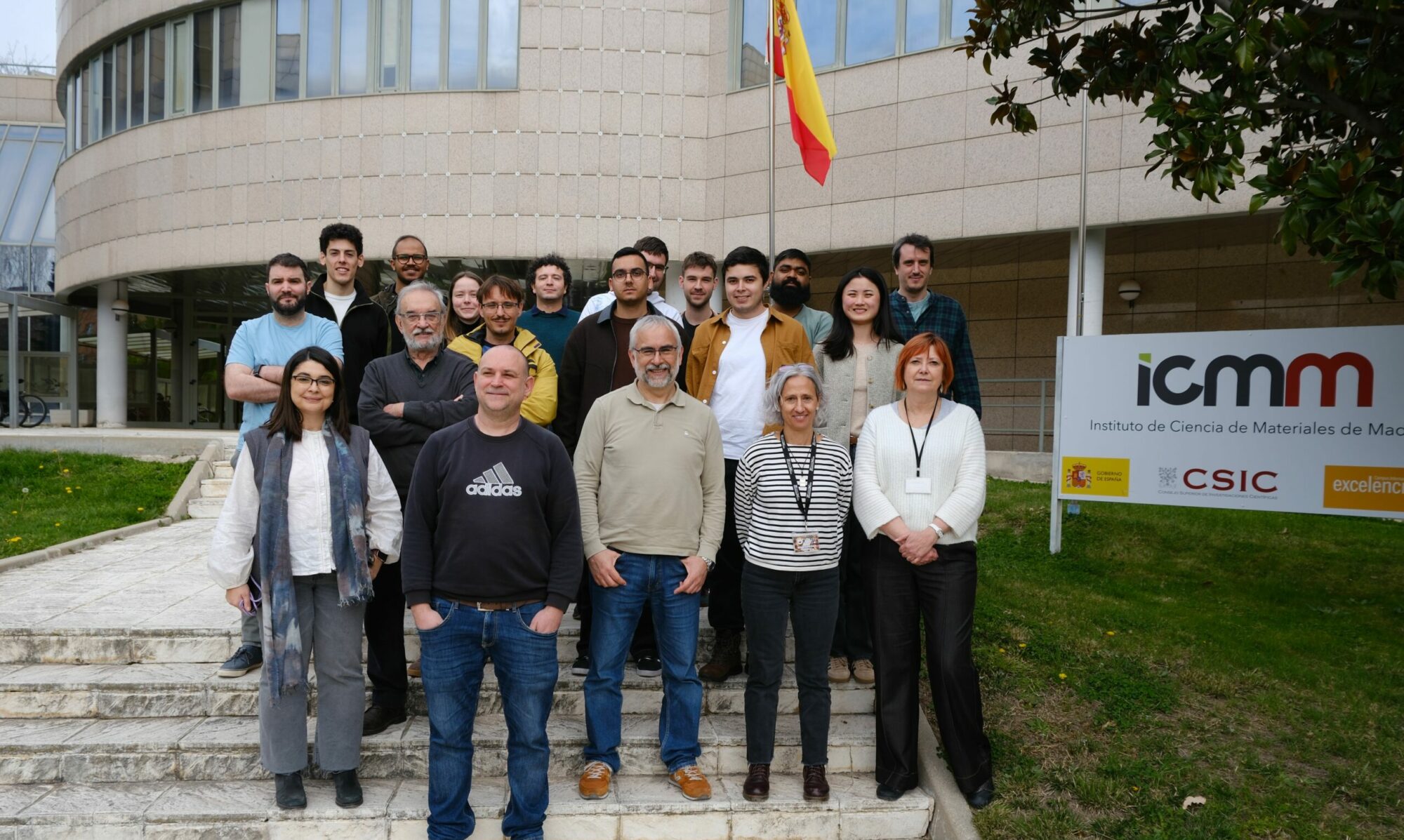
Soledad Aprea, PhD student from the National University of Cordoba (Argentina) is incorporated to the group until September 15th to work on “Magnetic Nanowires” under the supervision of Cristina Bran and Manuel Vazquez in the framework of the i- COOPB203017 project with that University funded by CSIC.

New article of the group

AIP Advances 9, 035114, 2019

Consequences of aging on ferromagnetic amorphous Fe75Si10B15 microwires for advanced inductive applications

X. Zhang, R. P. del Real, M. Vázquez and L. H. Lewis

doi.org/10.1063/1.5080098

Amorphous ferromagnetic microwires fabricated by in-water-quenching are assessed to show favorable properties as compared to those in sheet or ribbon form. In-water-quenched amorphous Fe75Si10B15 microwires prepared at ICMM/CSIC were subjected to aging up to 5 years time in air at room temperature. While both newer and aged microwires are X-ray amorphous, the aged ones exhibit a slight crystallinity degree, a lower initial susceptibility and a reduced enthalpy change for full devitrification. Such small differences (typically < 5%) are attributed to minor surface oxidation whose stress couples to magnetostriction to promote the formation of radial domains. This study demonstrates that amorphous microwires are essentially stable against aging in the air, a key point for advanced applications for next-generation high-frequency electric machines.


This article derives from the 2017 Sabbatical visit at the ICMM/CSIC of Prof. Laura H. Lewis from Northeastern University, Boston, funded by the National Science Foundation, U.S.A.

New people in the group

Guillermo Lopez-Polin obtained a Juan de la Cierva fellowship and
joined the group on April of 2019 under the supervision of Agustina
Asenjo. His project is about tuning the magnetic properties of 2D
materials with strain. He will be in the group until March of 2021.


New article of the group

Scientific Reports 9, 5130, 2019

Modeling magnetic-field-induced domain wall propagation in modulated-diameter cylindrical nanowires

J.A. Fernandez-Roldan, A. De Riz, B. Trapp, C. Thirion, M. Vazquez, J.-C. Toussaint, O. Fruchart and D. Gusakova

doi.org/10.1038/s41598-019-40794-1


Domain wall propagation in modulated-diameter cylindrical nanowires is a key phenomenon studied with a view to designing 3-dimensional magnetic memory devices. This paper presents a theoretical study of transverse domain wall behavior under magnetic field within a cylindrical nanowire with diameter modulation. Particularly, the domain wall pinning close to the diameter modulation was quantified, both numerically, using finite element micromagnetic simulations, and analytically. Qualitative analytical model for gently sloping modulations resulted in a simple scaling law useful to guide nanowire design when analyzing experiments. It shows that the domain wall depinning field is proportional to the modulation slope.

This article derives from the stay of Jose Angel Fernandez Roldan as PhD student in the laboratories of the Institut Louis Néel, Université Grenoble Alpes, CNRS, France supported by the Spanish MINECO within the collaboration established with Prof. Olivier Fruchart.