Beyond Hexagons: A Narrow-Gap Graphenic Polymer Built from [7–5–5] Rings

Introducing nonhexagonal rings into π-conjugated frameworks provides a means of controlling the electronic structure of low-dimensional carbon materials. We use thermally activated Ullmann coupling on Au(111) to prepare a nonalternant polymer containing cyclopenta[c,d]azulene (CPA) units. Bond-resolved scanning tunneling microscopy shows that the fused [7–5–5] ring system remains intact upon polymerization.Scanning…
Continue reading

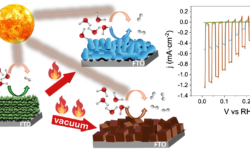
A new route to high-performance nanostructured CuO photocathodes

  We have developed a new fabrication strategy for producing nanostructured CuO photocathodes based on the deposition of CuO nanoparticles generated by a sputter gas aggregation source, followed by an optimized thermal treatment. This approach enables precise control over the structural evolution of the nanoparticle films, promoting their recrystallization into…

Continue reading

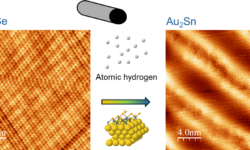
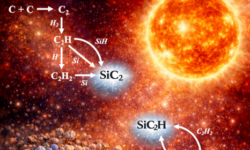
New insights into the role of hydrogen in cosmic silicon carbide synthesis

In this work, we investigate the formation mechanisms of silicon carbide cosmic dust under conditions mimicking the atmospheres of evolved carbon-rich stars. By combining ultra-high vacuum experiments, advanced spectroscopy and microscopy techniques, and theoretical modelling, we demonstrate the key role played by molecular hydrogen in triggering the chemical pathways that…

Continue reading

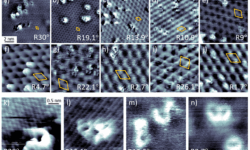
Moiré-Induced Enhanced Hydrogen Adsorption on Graphene

Tailoring the adsorption properties of 2D materials for targeted chemical processes is a central challenge in surface science. In particular, modulating hydrogen binding on graphene has strong relevance for catalysis and energy applications. In this study, we investigate hydrogen chemisorption across ten distinct moiré superstructures formed by graphene on various…

Continue reading

On-surface synthesis of metal-organic oligomers from photoactive BOPHY molecules and native adatoms

Synthesizing new low-dimensional materials with tailored functionalities for specific applications remains a major challenge in the field of on-surface synthesis. Among these materials, polymers incorporating photoactive moieties stand out as promising candidates for photocatalytic applications, given the exceptional photocatalytic activity exhibited by their bulk counterparts. In this work, following an…

Continue reading

Concavity vs convexity: what is the role of molecular configuration on the reaction pathway?

The role of stereochemistry—the spatial arrangement of atoms within molecules—on the reaction pathway has been largely overlooked in on-surface synthesis despite being crucial in organic chemistry. In this work, we demonstrate how the starting diastereomeric configuration can drive the surface-induced transformation of a substituted cyclooctatetraene (COT) structure—a key molecule in…

Continue reading

Design and Synthesis of a 2D Cu-Coordinated Carbon Nitride Network: A Promising Single-Atom Catalyst for Environmental Applications

Metal-coordinated networks are promising catalysts for environmental applications like green hydrogen production and pollutant photo-degradation. While traditionally 3D, recent efforts have extended these networks to 2D, though synthesis and stability remain challenging. Using a bottom-up approach, we successfully designed and synthesized a 2D hexagonal carbon nitride Cu-coordinated network by combining…

Continue reading