New article of the group

Scientific Reports 9, 5130, 2019

Modeling magnetic-field-induced domain wall propagation in modulated-diameter cylindrical nanowires

J.A. Fernandez-Roldan, A. De Riz, B. Trapp, C. Thirion, M. Vazquez, J.-C. Toussaint, O. Fruchart and D. Gusakova

doi.org/10.1038/s41598-019-40794-1


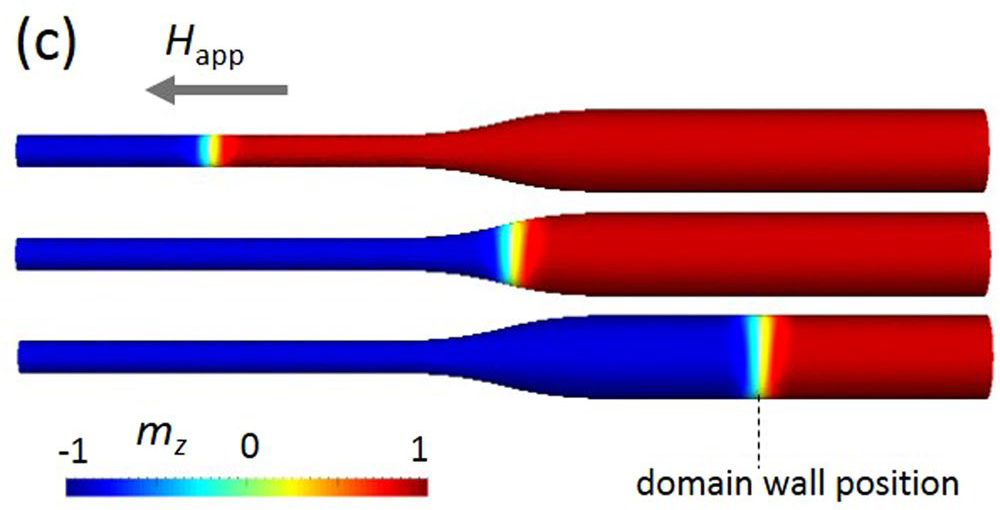
Domain wall propagation in modulated-diameter cylindrical nanowires is a key phenomenon studied with a view to designing 3-dimensional magnetic memory devices. This paper presents a theoretical study of transverse domain wall behavior under magnetic field within a cylindrical nanowire with diameter modulation. Particularly, the domain wall pinning close to the diameter modulation was quantified, both numerically, using finite element micromagnetic simulations, and analytically. Qualitative analytical model for gently sloping modulations resulted in a simple scaling law useful to guide nanowire design when analyzing experiments. It shows that the domain wall depinning field is proportional to the modulation slope.
This article derives from the stay of Jose Angel Fernandez Roldan as PhD student in the laboratories of the Institut Louis Néel, Université Grenoble Alpes, CNRS, France supported by the Spanish MINECO within the collaboration established with Prof. Olivier Fruchart.
New article of the group


Scripta Materialia 162, 397, 2019

Strain-magnetization effect in superelastic Ni-Mn-Ga microfiber

Yangyong Zhao, Maodong Kang, Jing Xue, Jiang Ju, Mengmeng Wang, Shubin Wang, Yong Zhang, Manuel Vázquez, Haiyan Gao, Jun Wang

doi.org/10.1016/j.scriptamat.2018.12.002

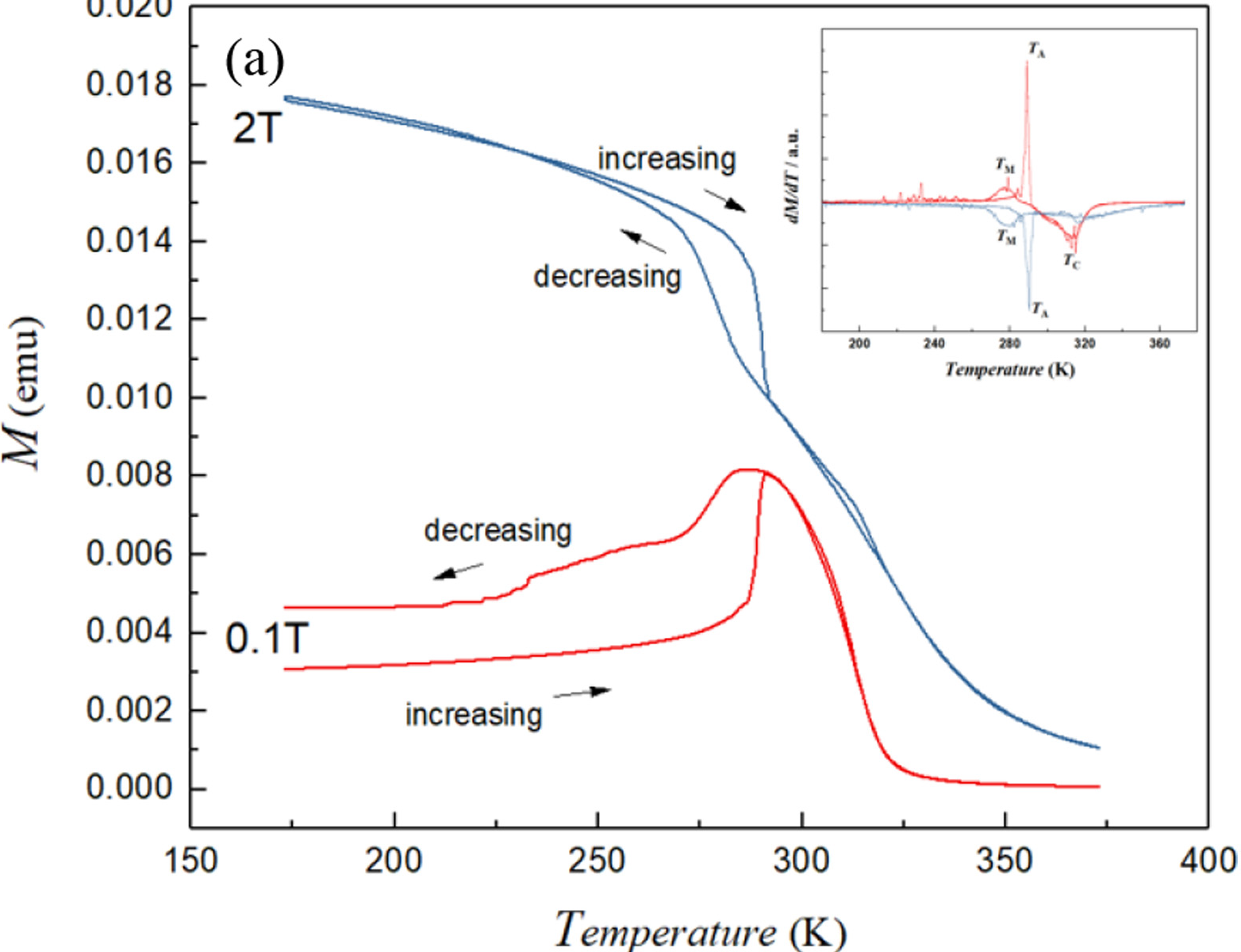
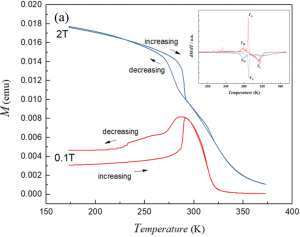
Ni-Mn-Ga microfiber with a diameter of 80 μm was produced by glass-coated melt spinning method at the laboratories of ICMM/CSIC. Its martensitic transformation and reverse transformation temperature are 279 K and 290 K, respectively. The as-cast microfiber shows nearly fully recoverable superelastic strain as large as ~10%, and perfect strain-magnetization effect, as the stress-induced martensite phase has lower initial susceptibility and higher saturation magnetization than the austenite one. This microfiber has large perspectives as non-destructive and non-contact monitor sensing material.

This article derives from the stay of Yangyong Zhao in the GNMP group in 2017 within the collaboration established with Prof. Yong Zhang from the State Key Laboratory of Advanced Metals and Materials, University of Science and Technology Beijing, China.

New people in the group

Associate Professor Mattia Butta is visiting us during the year 2019 to develop a project on “Magnetic microwires as sensing elements in orthogonal flux-gate sensors” supported by the Czech Technical University in Prague within its Bilateral Agreement with CSIC.

New people in the group

We welcome Alejandro Armengod, student of 4th course of Chemistry Engineering (Universidad Autónoma de Madrid). He joins our group until 10th of May.  He is going to carry out scientific internship in the topic «electrochemist fabrication of magnetic multilayered Co-Pt nanowires» under the supervision of Manuel Vázquez and Cristina Bran.