News
COVID-19 has not stopped the activity of the group. Those are the papers published during 2020:
Quitério, P., Apolinário, A., Navas, D., Magalhães, S., Alves, E., Mendes, A., Sousa, C.T., Araújo, J.P.
Photoelectrochemical Water Splitting: Thermal Annealing Challenges on Hematite Nanowires
(2020) Journal of Physical Chemistry C, 124 (24), pp. 12897-12911.
DOI: 10.1021/acs.jpcc.0c012
—————————————————————
Peixoto, L., Magalhães, R., Navas, D., Moraes, S., Redondo, C., Morales, R., Araújo, J.P., Sousa, C.T.
Magnetic nanostructures for emerging biomedical applications
(2020) Applied Physics Reviews, 7 (1), art. no. 011310, .
DOI: 10.1063/1.5121702
—————————————————————
Verba, R.V., Navas, D., Bunyaev, S.A., Hierro-Rodriguez, A., Guslienko, K.Y., Ivanov, B.A., Kakazei, G.N.
Helicity of magnetic vortices and skyrmions in soft ferromagnetic nanodots and films biased by stray radial fields
(2020) Physical Review B, 101 (6), art. no. 064429, .
DOI: 10.1103/PhysRevB.101.064429
—————————————————————
Otxoa, R.M., Atxitia, U., Roy, P.E., Chubykalo-Fesenko, O.
Giant localised spin-Peltier effect due to ultrafast domain wall motion in antiferromagnetic metals
(2020) Communications Physics, 3 (1), art. no. 31, .
DOI: 10.1038/s42005-020-0296-4
—————————————————————
Catalán-Gómez, S., Bran, C., Vázquez, M., Vázquez, L., Pau, J.L., Redondo-Cubero, A.
Plasmonic coupling in closed-packed ordered gallium nanoparticles
(2020) Scientific Reports, 10 (1), art. no. 4187, .
DOI: 10.1038/s41598-020-61090-3
—————————————————————
Vedmedenko, E.Y., Kawakami, R.K., Sheka, D.D., Gambardella, P., Kirilyuk, A., Hirohata, A., Binek, C., Chubykalo-Fesenko, O., Sanvito, S., Kirby, B.J., Grollier, J., Everschor-Sitte, K., Kampfrath, T., You, C.-Y., Berger, A.
The 2020 magnetism roadmap
(2020) Journal of Physics D: Applied Physics, 53 (45), art. no. 453001, .
DOI: 10.1088/1361-6463/ab9d98
—————————————————————
Meneses, F., Bran, C., Vázquez, M., Bercoff, P.G.
Enhanced in-plane magnetic anisotropy in thermally treated arrays of Co-Pt nanowires
(2020) Materials Science and Engineering B: Solid-State Materials for Advanced Technology, 261, art. no. 114669, .
DOI: 10.1016/j.mseb.2020.114669
—————————————————————
Alam, J., Bran, C., Chiriac, H., Lupu, N., Óvári, T.A., Panina, L.V., Rodionova, V., Varga, R., Vazquez, M., Zhukov, A.
Cylindrical micro and nanowires: Fabrication, properties and applications
(2020) Journal of Magnetism and Magnetic Materials, 513, art. no. 167074, .
DOI: 10.1016/j.jmmm.2020.167074
—————————————————————
Algueró, M., Pérez-Cerdán, M., del Real, R.P., Ricote, J., Castro, A.
Novel Aurivillius Bi4Ti3−2xNbxFexO12phases with increasing magnetic-cation fraction until percolation: a novel approach for room temperature multiferroism
(2020) Journal of Materials Chemistry C, 8 (36), pp. 12457-12469.
DOI: 10.1039/d0tc03210g
—————————————————————
Berganza, E., Jaafar, M., Fernandez-Roldan, J.A., Goiriena-Goikoetxea, M., Pablo-Navarro, J., García-Arribas, A., Guslienko, K., Magén, C., De Teresa, J.M., Chubykalo-Fesenko, O., Asenjo, A.
Half-hedgehog spin textures in sub-100 nm soft magnetic nanodots
(2020) Nanoscale, 12 (36), pp. 18646-18653.
DOI: 10.1039/d0nr02173c
—————————————————————
Dieny, B., Prejbeanu, I.L., Garello, K., Gambardella, P., Freitas, P., Lehndorff, R., Raberg, W., Ebels, U., Demokritov, S.O., Akerman, J., Deac, A., Pirro, P., Adelmann, C., Anane, A., Chumak, A.V., Hirohata, A., Mangin, S., Valenzuela, S.O., Onbaşlı, M.C., d’Aquino, M., Prenat, G., Finocchio, G., Lopez-Diaz, L., Chantrell, R., Chubykalo-Fesenko, O., Bortolotti, P.
Opportunities and challenges for spintronics in the microelectronics industry
(2020) Nature Electronics, 3 (8), pp. 446-459.
DOI: 10.1038/s41928-020-0461-5
—————————————————————
Fernandez-Roldan, J.A., Del Real, R.P., Bran, C., Vazquez, M., Chubykalo-Fesenko, O.
Electric current and field control of vortex structures in cylindrical magnetic nanowires
(2020) Physical Review B, 102 (2), art. no. 024421, .
DOI: 10.1103/PhysRevB.102.024421
—————————————————————
Pulzara-Mora, C., Pulzara-Mora, A., Forero-Pico, A., Ayerbe-Samaca, M., Marqués-Marchán, J., Asenjo, A., Nemes, N.M., Arenas, D., Sáez Puche, R.
Structural, morphological and magnetic properties of GaSbMn/Si(111) thin films prepared by radio frequency magnetron sputtering
(2020) Thin Solid Films, 705, art. no. 137971, .
DOI: 10.1016/j.tsf.2020.137971
—————————————————————
Olleros-Rodríguez, P., Guerrero, R., Camarero, J., Camarero, J., Chubykalo-Fesenko, O., Perna, P.
Intrinsic Mixed Bloch-Néel Character and Chirality of Skyrmions in Asymmetric Epitaxial Trilayers
(2020) ACS Applied Materials and Interfaces, 12 (22), pp. 25419-25427.
DOI: 10.1021/acsami.0c04661
—————————————————————
Simeonidis, K., Martinez-Boubeta, C., Serantes, D., Ruta, S., Chubykalo-Fesenko, O., Chantrell, R., Oró-Solé, J., Balcells, L., Kamzin, A.S., Nazipov, R.A., Makridis, A., Angelakeris, M.
Controlling Magnetization Reversal and Hyperthermia Efficiency in Core-Shell Iron-Iron Oxide Magnetic Nanoparticles by Tuning the Interphase Coupling
(2020) ACS Applied Nano Materials, 3 (5), pp. 4465-4476.
DOI: 10.1021/acsanm.0c00568
—————————————————————
Jaafar, M., Pablo-Navarro, J., Berganza, E., Ares, P., Magén, C., Masseboeuf, A., Gatel, C., Snoeck, E., Gómez-Herrero, J., de Teresa, J.M., Asenjo, A.
Customized MFM probes based on magnetic nanorods
(2020) Nanoscale, 12 (18), pp. 10090-10097.
DOI: 10.1039/d0nr00322k
—————————————————————
Cacilhas, R., De Araujo, C.I.L., Carvalho-Santos, V.L., Moreno, R., Chubykalo-Fesenko, O., Altbir, D.
Controlling domain wall oscillations in bent cylindrical magnetic wires
(2020) Physical Review B, 101 (18), art. no. 184418, .
DOI: 10.1103/PhysRevB.101.184418
—————————————————————
Shcherbinin, S.V., Perez, R., Vazquez, M., Kurlyandskaya, G.V.
Ferromagnetic Resonance in Electroplated CuBe/FeCoNi and Amorphous CoFeSiB Wires
(2020) IEEE Transactions on Magnetics, 56 (4), art. no. 8999601, .
DOI: 10.1109/TMAG.2020.2974141
—————————————————————
Calle, E., Vázquez, M., P. del Real, R.
Time-resolved motion of a single domain wall controlled by a local tunable barrier
(2020) Journal of Magnetism and Magnetic Materials, 498, art. no. 166093, .
DOI: 10.1016/j.jmmm.2019.166093
—————————————————————
Kaidatzis, A., del Real, R.P., Alvaro, R., Niarchos, D., Vázquez, M., García-Martín, J.M.
Nanopatterned hard/soft bilayer magnetic antidot arrays with long-range periodicity
(2020) Journal of Magnetism and Magnetic Materials, 498, art. no. 166142, .
DOI: 10.1016/j.jmmm.2019.166142
—————————————————————
Butta, M., Vazquez, M., Perez Del Real, R., Calle, E.
Dependence of the noise of an orthogonal fluxgate on the composition of its amorphous wire-core
(2020) AIP Advances, 10 (2), art. no. 025114, .
DOI: 10.1063/1.5130393
—————————————————————
Bollero, A., Neu, V., Baltz, V., Serantes, D., Cuñado, J.L.F., Pedrosa, J., Palmero, E.M., Seifert, M., Dieny, B., Del Real, R.P., Vázquez, M., Chubykalo-Fesenko, O., Camarero, J.
An extraordinary chiral exchange-bias phenomenon: Engineering the sign of the bias field in orthogonal bilayers by a magnetically switchable response mechanism
(2020) Nanoscale, 12 (2), pp. 1155-1163.
DOI: 10.1039/c9nr08852k
New paper of the group
“Extraordinary Chiral Exchange-Bias Phenomenon: Engineering the Sign of the Bias Field in Orthogonal Bilayers by a Magnetically Switchable Response Mechanism”
Alberto Bollero, Volker Neu, Vincent Baltz, David Serantes, José Luis F. Cuñado, Javier Pedrosa, Ester M. Palmero, Marietta Seifert, Bernard Dieny, Rafael P. del Real, Manuel Vázquez, Oksana Chubykalo-Fesenko and Julio Camarero
Nanoscale, 2020
DOI: 10.1039/C9NR08852K
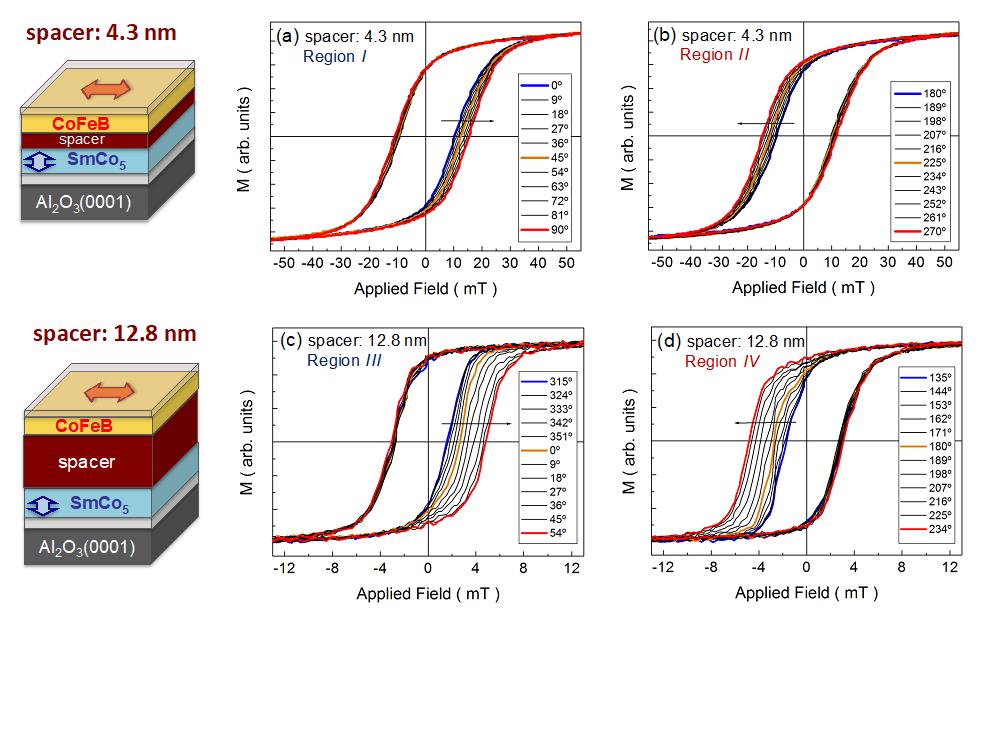
Isothermal tuning of magnitude and sign of the bias field has been achieved by exploiting a new phenomenon in a system consisting of two orthogonally coupled films: SmCo5 (out-of-plane anisotropy)-CoFeB (in-plane anisotropy). This has been managed by using the large dipolar magnetic field of the SmCo5 layer resulting in pinning one branch of the loop (either ascending or descending branch) at a fixed field value while the second one is modulated along the field axis by varying the orientation of an applied magnetic field. This enables the control of the sign of the bias field in a novel manner. Moreover, modulation of the bias field strength is possible by varying the thickness of a spacer between the SmCo5 and CoFeB layers. This study shows that the observed phenomena find their origin in the competition of artificially induced anisotropies on both layers, resulting in a reversible chiral bias effect that allows selecting the initial sign of the bias field by switching (upwards/downwards) the magnetization in the SmCo5 film.

The figure shows the in-plane hysteresis loops measured by MOKE with magnetic field applied at different in-plane angles for: (a) and (b) SmCo5(30nm)/spacer(4.3nm)/CoFeB(3nm); and (c) and (d) SmCo5(30nm)/spacer(12.8nm)/CoFeB(3nm). aH = 0° corresponds to applied magnetic field parallel to the easy axis direction of the Si/SiO2/CoFeB reference sample. Arrows are visual guides to show the continuous increase in coercivity when varying the field while keeping pinned one of the loop branches.
This work, in collaboration with IMDEA Nanoscience, Madrid; IFW Dresden; SPINTEC, Univ. Grenoble Alpes/CNRS/CEA and the Univ. Autónoma de Madrid, has been supported partly by the Spanish Ministry of Economy, Industry and Competitiveness (MINECO) under project MAT2016-76824-C3-1-R and by the Regional Government of Madrid under project S2018/NMT-4321 NANOMAGCOST-CM.
New paper of the group
«Exotic Transverse-Vortex Magnetic Configurations in CoNi Nanowires»
Ingrid Marie Andersen, Luis Alfredo Rodríguez, Cristina Bran, Cécile Marcelot, Sébastien Joulie, Teresa Hungria, Manuel Vázquez, Christophe Gatel and Etienne Snoeck
ACS Nano, December 11, 2019
DOI: https://doi.org/10.1021/acsnano.9b07448
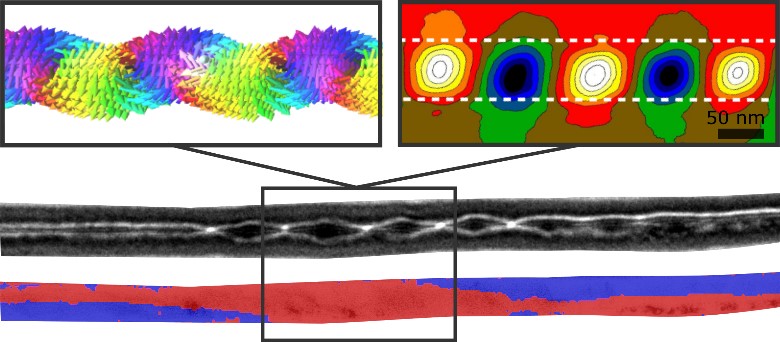
The magnetic configurations of cylindrical Co-rich CoNi nanowires have been quantitatively analyzed at the nanoscale by electron holography and correlated to local structural and chemical properties. The nanowires display grains of both face-centered cubic (fcc) and hexagonal close-packed (hcp) crystal structures, with grain boundaries parallel to the nanowire axis direction. Electron holography evidences the existence of a complex exotic magnetic configuration characterized by two distinctly different types of magnetic configurations within a single nanowire: an array of periodical vortices separating small transverse domains in hcp rich regions with perpendicular easy axis orientation, and a mostly axial configuration parallel to the nanowire axis in regions with fcc grains. These vastly different domains are found to be caused by local variations in the chemical composition modifying the crystalline orientation and/or structure, which give rise to change in magnetic anisotropies. Micromagnetic simulations, including the structural properties that have been experimentally determined, allows for a deeper understanding of the complex magnetic states observed by electron holography.

This work derives from the current collaboration between our GNMP group and CEMES – CNRS, Toulouse, France. It has been partly supported by the Spanish Ministry of Economy, Industry and Competitiveness (MINECO) under project MAT2016-76824-C3-1-R and by the Regional Government of Madrid under project S2018/NMT-4321 NANOMAGCOST-CM