New projects

The group has been awarded with two i-LINK projects supported by CSIC for the period 2019-2020:

i-LINKA20052  “Nanorobots and sensors based on magnetic nanowires”

Coordinated by Manuel Vázquez, and partners from Institute of Robotics and Intelligent Systems at ETH, Zurich (Dr. S. Pané), Sensing, Magnetism and Microsystems group at KAUST, Thuwal, Saudi Arabia (Ass. Prof. J. Kosel), Functional Materials group at University of Vienna (Dr. Ch. Vogler), Nanomagnetism team of Quantum Detection Group at National Physical Laboratory NPL; Teddington, UK (Dr. O. Kazakova) and SuessCo  Sensors GmbH, Herzogenburg, Austria (Eng. R. Windl).


i-LINKA20074 “Towards a personalized medicine: a proof of concept”

Coordinated by Rafael Pérez, and partners from Nanomagnetism Laboratory at University of Northeastern, Boston, EEUU (Prof. Laura H. Lewis),  Laboratory of Nanosensors for Chemical Imaging of Living Systems at University of Northeastern, Boston, EEUU (Prof. Heather Clark) and the Department of Chemical Engineering at University of Monash, Australia (Dr. Simon Corrie).
New people in the group

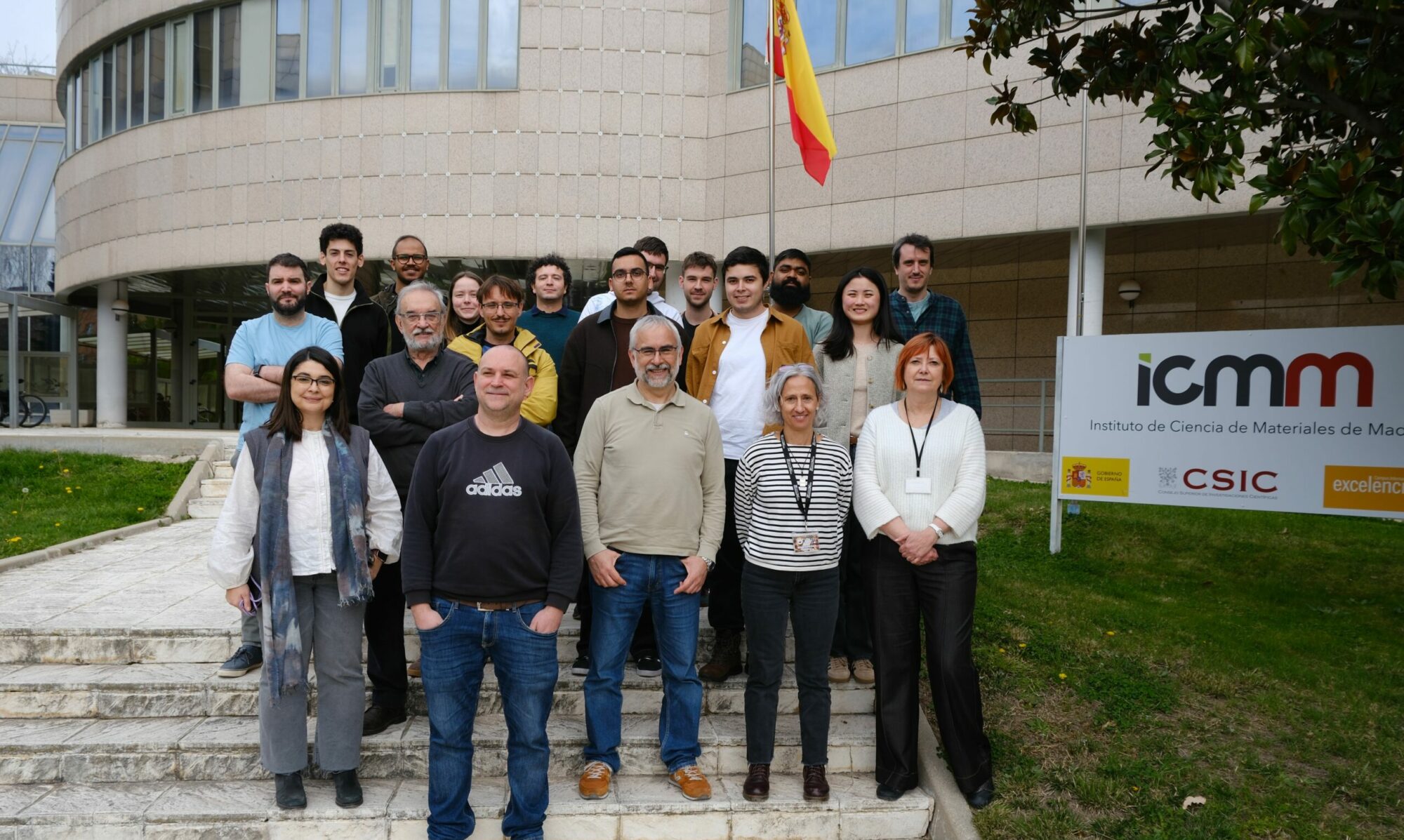
Prof. Laura H. Lewis is visiting us again under the auspices of the program supported by Fulbright España from May to August 2019. Laura is the Distinguished University and Cabot Professor of Chemical Engineering, and Professor of Mechanical and Industrial Engineering at Northeastern University in Boston, MA, U.S.A. Her current collaborative research with our group is focusing on “advanced applications of amorphous magnetic microwires”.

New Seminar

«3D arrays of magnetic nanowires” by Dr. Yuri Ivanov from the Material Science and Metallurgy Department, University of Cambridge, May 16th .

New article of the group

NanoResearch

Stepwise magnetization reversal of geometrically tuned in diameter Ni and FeCo bi-segmented nanowire arrays

Ester M. Palmero, Miguel Méndez, Silvia González, Cristina Bran, Víctor Vega, Manuel Vázquez and Víctor M. Prida

https://doi.org/10.1007/s12274-019-2385-9

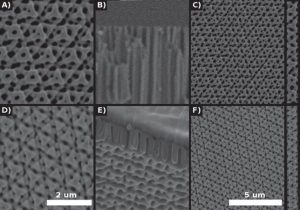
The magnetization process of hexagonal dense arrays of bi-segmented Ni and FeCo nanowires consisting of two well defined diameters (45 and 80 nm) are reported. The nanowires were grown inside of tailored pores of anodic alumina templates by combined anodization, atomic layer deposition (ALD) and electrodeposition. The results clearly enable to identify a two-step process ascribed to the respective segments of different diameter, as concluded from the differential susceptibility of the loops, and confirmed by the first-order reversal curve (FORC) distribution diagrams, where an elongation parallel to the interaction axis around two coercive field values is obtained. This well-defined two-step magnetization reversal process through the nanowire diameter design represents a promising route for the advanced control of the remagnetization in arrays of magnetic multidomain systems.

This study performed in collaboration with the University of Oviedo has been supported by the Spanish Ministerio de Economia y Competitividad (MINECO) under the coordinated research Projects MAT2013-48054-C2 and MAT2016-76824-C3.