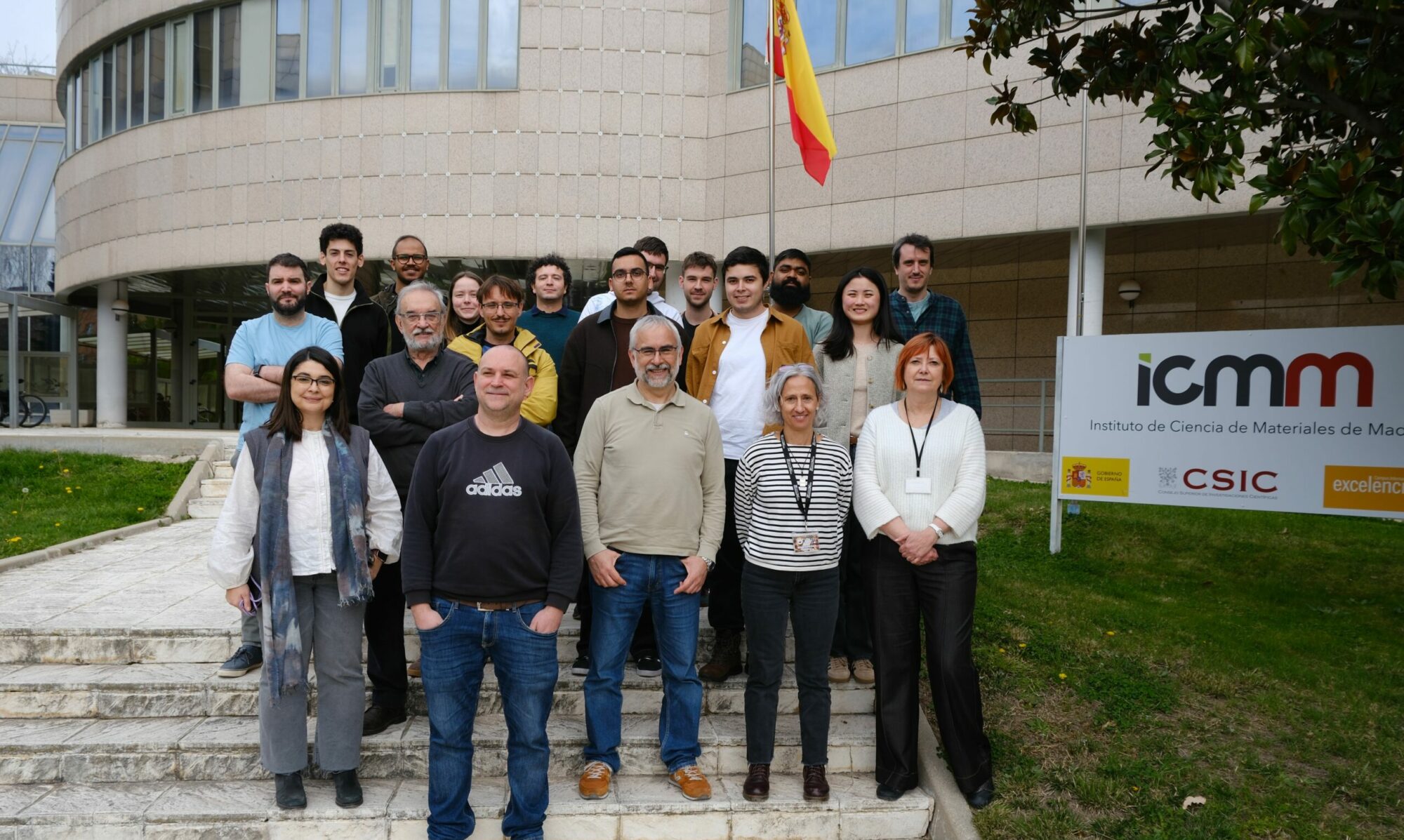

New people in the group

Paul-Iulian Gavriloaea will make his PhD (Large-scale modelling of combined all-optical and/or electric switching) with us under the supervision of Oksana Fesenko.  The PhD project is part of the Marie Skłodowska-Curie Action COMRAD (Cold Opto-Magnetism for Random Access Devices). The key aim of the consortium is to combine spin-orbitronics with ultrafast magnetism towards the development of faster (sub 100 ps) and greener (< 10 fJ/bit) random access devices. In general lines, my project is based on further developing the finite-temperature micromagnetic framework based on the Landau-Lifshitz-Bloch equation to accommodate for electrical fields/currents or spin-orbit torques in the modelling of laser induced magnetisation dynamics. We will be using the code to describe the switching process in various multilayer structures such as Co/Pt or Pt/Co/Gd and ferrimagnets (e.g. RFeCo/Pt, where R is a Rare Earth). Furthermore, the model will be also used to assist various real switching scenarios aiming to replicate experimental results or help predict the most efficient routes to reversal.

New paper in the group

The effect of rippling on the mechanical properties of graphene

Guillermo Lopez-Polin, Cristina Gomez-Navarro, Julio Gomez-Herrero

Nano Materials Science 2021

DOI: https://doi.org/10.1016/j.nanoms.2021.05.005

Graphene is the stiffest material known so far but, due to its one-atom thickness, it is also very bendable. Consequently, free-standing graphene exhibit ripples that has major effects on its elastic properties. Here we will summarize three experiments where the influence of rippling is essential to address the results. Firstly, we observed that atomic vacancies lessen the negative thermal expansion coefficient (TEC) of free-standing graphene. We also observed an increase of the Young’s modulus with global applied strain and with the introduction of small density defects that we attributed to the decrease of rippling. Here, we will focus on a surprising feature observed in the data: the experiments consistently indicate that only the rippling with wavelengths between 5 and 10 ​nm influences the mechanics of graphene. The rippling responsible of the negative TEC and anomalous elasticity is thought to be dynamic, i.e. flexural phonons. However, flexural phonons with these wavelengths should have minor effects on the mechanics of graphene, therefore other mechanisms must be considered to address our observations. We propose static ripples as one of the key elements to correctly understand the thermomechanics of graphene and suggest that rippling arises naturally due to a competition of symmetry breaking and anharmonic fluctuations.


New international award

Prof. Manuel Vazquez

The IEEE Magnetics Society Distinguished Service Award is established to honor outstanding service to the Magnetics Society

Prof. Manuel Vazquez from the Institute of Materials Science of Madrid, CSIC, has been granted the 2021 Distinguished Service Award.

The citation reads: For tremendously strengthening the IEEE Magnetics Society outreach worldwide and dedicated efforts to engage new people in service to the society

New paper of the group

Magnetic Configurations in Modulated Cylindrical Nanowires

Cristina Bran, Jose Angel Fernandez-Roldan, Rafael P. del Real, Agustina Asenjo, Oksana Chubykalo-Fesenko and Manuel Vazquez

Nanomaterials 2021, 11, 600

DOI: doi.org/10.3390/nano11030600

Cylindrical magnetic nanowires show great potential for 3D applications such as magnetic recording, shift registers, and logic gates, as well as in sensing architectures or biomedicine. Their cylindrical geometry leads to interesting properties of the local domain structure, leading to multifunctional responses to magnetic fields and electric currents, mechanical stresses, or thermal gradients. This review article summarizes the work carried out in our group on the fabrication and magnetic characterization of cylindrical magnetic nanowires with modulated geometry and anisotropy. The nanowires are prepared by electrochemical methods with precise control over geometry, morphology, and composition. Different routes to control the magnetization configuration and its dynamics through the geometry and magnetocrystalline anisotropy are presented. The diameter modulations change the typical single domain state present in cubic nanowires, providing the possibility to confine or pin circular domains or domain walls in each segment. The control and stabilization of domains and domain walls in cylindrical wires has been achieved in multisegmented structures by alternating magnetic segments of different magnetic properties or with non-magnetic layers.

This article reviews the most significant investigations carried out by the GNMP group on cylindrical magnetic nanowires with modulated geometry and anisotropy. Such modulations promote the occurrence of stable magneto-chiral structures and provide further information for the design of cylindrical nanowires for multiple applications.