New paper of the group

On the path to novel magnetic cores: Electromagnetic simulations of amorphous magnetic microwires for inductive applications

C. Johnson, X. Zhang, D. Li, R. P. del Real, S. Pakdelian, M. Vázquez, L. H. Lewis and B. Lehman

AIP Advances 11 (2021) 015211

DOI: doi.org/10.1063/9.0000205

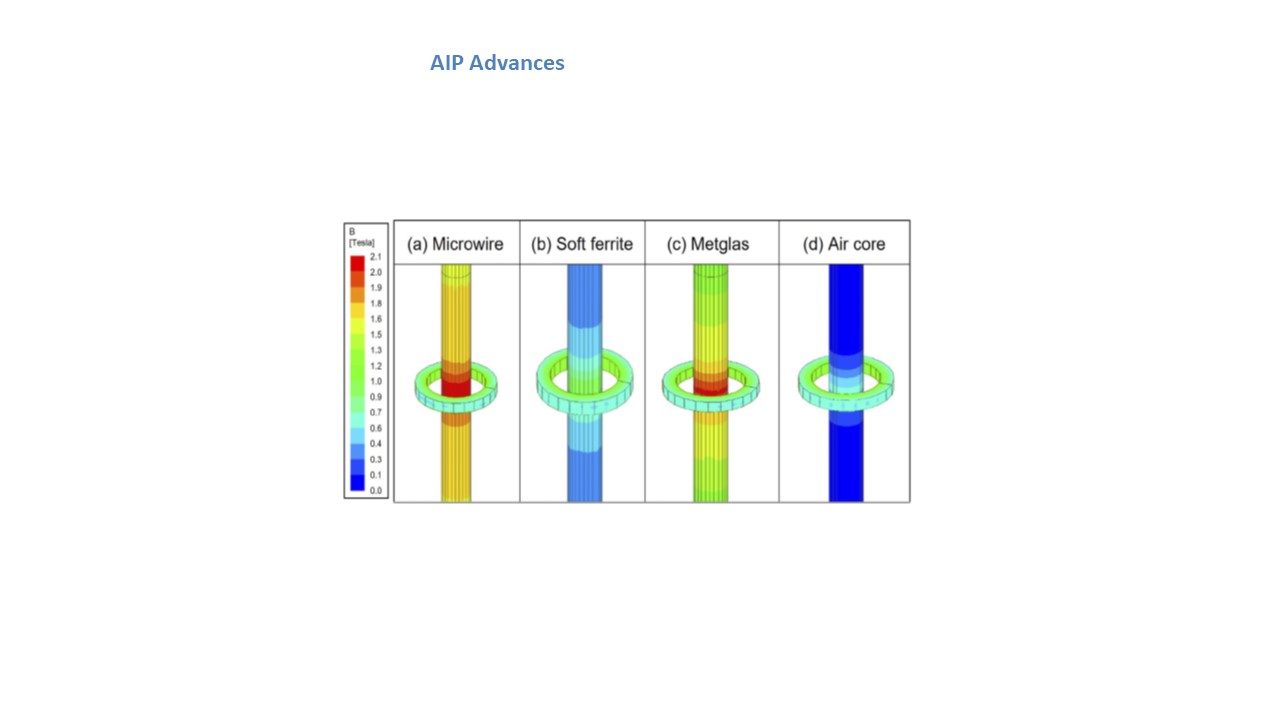
The potential of water-quenched amorphous magnetic microwires in magnetic core applications is assessed by electromagnetic simulation performed on microwires incorporated into two configurations: (1) a regular rod inductor and (2) an air-gapped toroidal inductor. Each model utilizes a cylindrical magnetic element of 100 microns in diameter, surrounded by a copper winding element that carries an alternating current at frequency f=100 kHz. These models consider amorphous Fe(Co)SiB microwires specified by their experimentally determined B-H response as well as two benchmark core materials – soft ferrite (MnZn-oxide type) and Metglas(2605SA1). Simulation results indicate that the microwire material exhibits a higher degree of magnetization alignment along its length under the electromagnetic field created by the loop current, relative to the other two cores. The microwire configuration also exhibits improved core inductance by as much as 30% compared to those of the other two materials. These results demonstrate that amorphous magnetic microwires have intriguing potential in inductive applications.

This work is the result of the international collaboration between the group GNMP, ICMM/CSIC and the Northeastern University of Boston, USA. It has been developed within the i-LinkA-20074 project funded by CSIC

New paper of the group

Novel Aurivillius Bi4Ti32xNbxFexO12 phases with increasing magnetic-cation fraction until percolation: a novel approach for room temperature multiferroism

Miguel Alguero,  Miguel Perez-Cerdan, Rafael P. del Real, Jesus Ricote and Alicia Castro

J. Mater. Chem. C, 2020, 8, 12457

DOI: 10.1039/d0tc03210grsc.li/materials-c


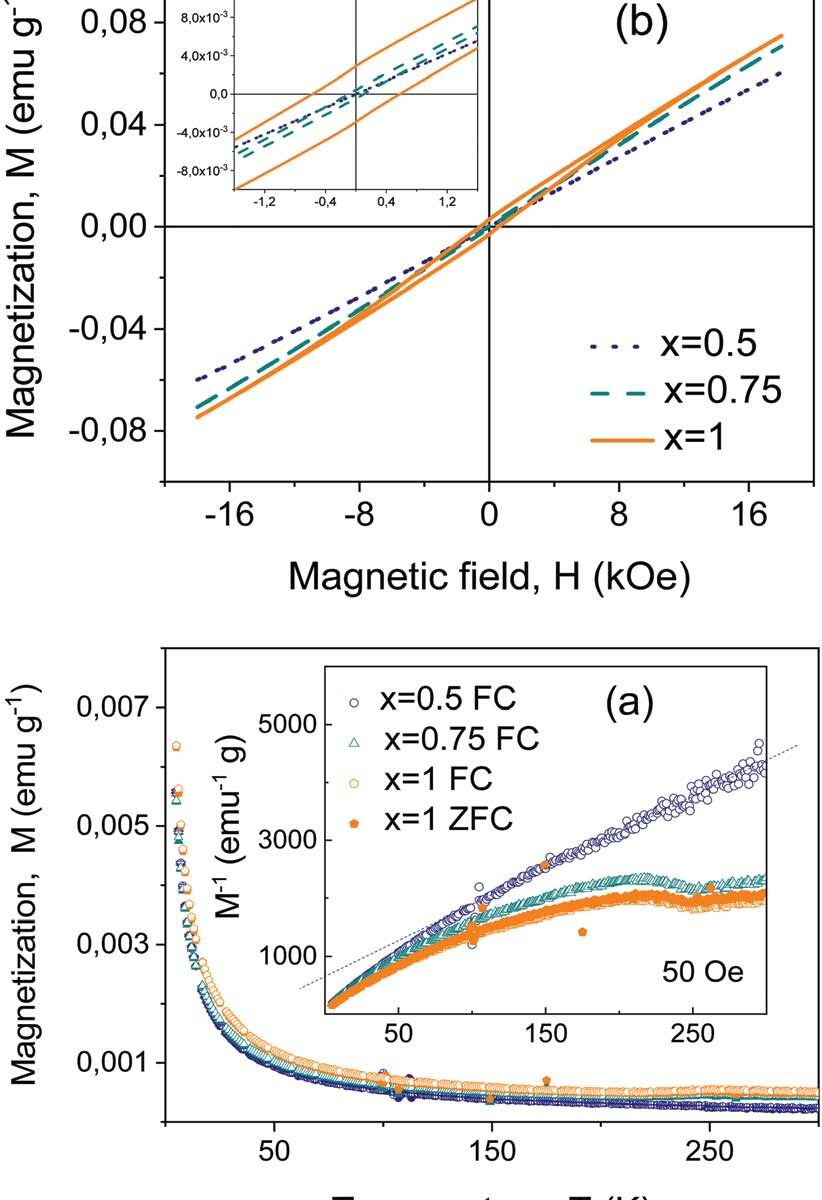
Aurivillius oxides with general formula (Bi2O2 (Am1BmO3m+1) are being extensively investigated for room-temperature multiferroism and magnetoelectric coupling. The chemical design strategy behind current investigations is the incorporation of magnetically active BiMO3 units (M: Fe3+, Mn3+, Co3+. . .) to the pseudoperovskite layer of known ferroelectrics like Bi4Ti3O12, increasing m. The percolation of magnetic cations at the B-site sublattice is required for magnetic ordering and thus, phases with m Z 5 are searched. Alternatively, one can try to directly substitute magnetic species for Ti4+ in the perovskite slab, without introducing additional oxygen octahedra. We report here the mechanosynthesis of Aurivillius Bi4Ti32xNbxFexO12 phases with increasing x values up to 1. A maximum magnetic fraction of 1/3, surpassing the threshold for percolation, was reached. Preliminary structural analysis indicated a continuous solid solution, though hints of structural changes between x = 0.25 and 0.5 were found.
Ceramic processing was accomplished by spark plasma sintering of the mechanosynthesized phases, including those with high-x ones with reduced thermal stability. This has enabled us to carry out full electrical characterization and to demonstrate ferroelectricity for all phases up to x = 1. Magnetic measurements were also carried out, and weak ferromagnetism was found for x = 1. Therefore, Bi4TiNbFeO12 is proposed to be a novel room-temperature multiferroic.

New technological project

“Research on the electromagnetic sensing adaptability to different clinical parameters”

In collaboration with the company Ortho Baltic, from Lithuania, supervised by M. Vazquez and R.P. del Real  

New PhD Thesis

“Continuous and nanopatterned TbCo based heterostructures with in-plane and perpendicular anisotropy

Nikita A. Kulesh, PhD by the Autonomous University of Madrid (Sobresaliente cum laude), supervised by Manuel Vázquez and Vladimir O. Vaskovskii

This thesis focuses on investigation of magnetic properties and magnetization reversal processes in continuous and antidot patterned TbCo ferrimagnetic amorphous films with perpendicular magnetic anisotropy (PMA). The search for new ways of tailoring magnetic anisotropy and hysteresis properties of magnetic films with PMA by adjusting their shape at the nanoscale level is the main objective.

In the first part, magnetic properties of amorphous TbCo films are investigated using auxiliary systems with simpler magnetic structures LaCo and GdCo. A possibility to produce TbCo layers having the same composition but different character of magnetic anisotropy is demonstrated. TbCo layers with PMA or in-plane magnetic anisotropy were used to induce unidirectional anisotropy in adjoining FeNi layers.

In the last part, micromagnetic simulation is employed to analyze and reproduce experimental results obtained for TbCo and GdCo antidot patterned films. An approach of step-by-step complication of micromagnetic model is used so separate and analyze sources of experimentally observed variations in magnetization processes.

This PhD research study derives from the collaboration with the Department of Magnetism and Magnetic Nanomaterials, Urals Federal University in Ekaterinburg.