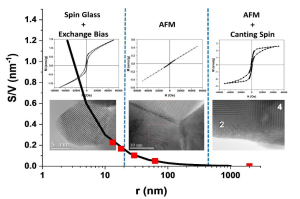
Transition from AFM Spin Canting to Spin Glass–AFM Exchange as Particle Size Decreases in LaFeO3

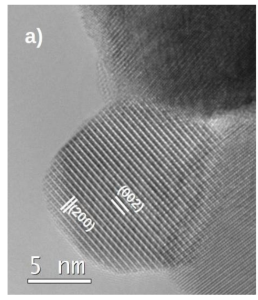
In this work, we have studied structural and magnetic properties of LaFeO3 as a function of the particle size d, from bulk (d >> 1 μm) to nanoscale (d ≈ 30 nm). A large number of twins were observed for large particles that disappear for small particle sizes. This could be related to the softening of the FeO6 distortion as particle size decreases. It was observed that the bulk sample showed spin canting that disappeared for d ~ 125 nm and can be associated with the smoothening of the orthorhombic distortion. On the other hand, for d < 60 nm, the surface/volume ratio became high and, despite the high crystallinity of the nanoparticle, a notable exchange effect bias appeared, originated by two magnetic interactions: spin glass and antiferromagnetism. This exchange bias interaction was originated by the formation of a “magnetic core–shell”: the broken bonds at the surface atoms give place to a spin glass behavior, whereas the inner atoms maintain the anti-ferromagnetic G-type order. The LaFeO3 bulk material was synthesized by the ceramic method, whereas the LaFeO3 nanoparticles were synthesized by the sol-gel method; the particle size was varied by annealing the samples at different temperatures. The physical properties of the materials have been investigated by XRD, HRTEM, TGA, and AC and DC magnetometry.

En este trabajo hemos estudiado las propiedades estructurales y magnéticas de LaFeO3 en función del tamaño de partícula d, desde un tamaño de partícula grande (d >> 1 μm) hasta nanoescala (d ≈ 30 nm). Se observó un gran número de maclas para partículas grandes que desaparecen para partículas pequeñas. Esto podría estar relacionado con el ablandamiento de la distorsión de los octaedros FeO6 a medida que disminuye el tamaño de las partículas. Se observó que la muestra másica mostró un “canting” de espín que desapareció para d ~ 125 nm y puede estar asociada con el suavizado de la distorsión ortorrómbica. Por otro lado, para d < 60 nm, la relación superficie/volumen se hizo elevada y, a pesar de la alta cristalinidad de la nanopartícula, apareció un notable “bias” por efecto de intercambio, originado por dos interacciones magnéticas: “spin glass” y antiferromagnetismo. Esta interacción de intercambio de “bias” se originó por la formación de un «core-shell” magnético: los enlaces rotos en los átomos de la superficie dan lugar a un comportamiento de vidrio de espín, mientras que los átomos internos mantienen el orden antiferromagnético de tipo G. El material másico de LaFeO3 se sintetizó mediante el método cerámico, mientras que las nanopartículas de LaFeO3 se sintetizaron mediante el método sol-gel; el tamaño de partícula se varió recociendo las muestras a diferentes temperaturas. Las propiedades físicas de los materiales se han investigado mediante XRD, HRTEM, TGA y magnetometría AC y DC.

D. Alshalawi, J. M. Alonso, A. R. Landa-Cánovas, and P. de la Presa, “Transition from AFM Spin Canting to Spin Glass–AFM Exchange as Particle Size Decreases in LaFeO3,” Nanomaterials 13, 1657 (2023)
Publicado en HRTEM, Publications, transition metal oxides | Comentarios desactivados en Transition from AFM Spin Canting to Spin Glass–AFM Exchange as Particle Size Decreases in LaFeO3

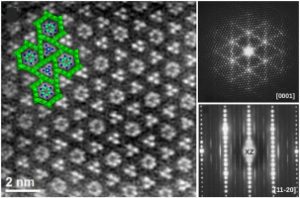
TEM study of ∼PbCr2S4 columnar misfit phases


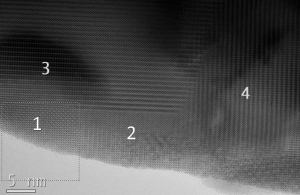
The disordered structure of the columnar misfit ​ ​PbCr2S4 phase (∼ character indicates that it is close to the stoichiometric composition but slightly away) has been revealed by means of transmission electron microscopy (TEM) varied techniques such as selected area electron diffraction (SAED), high-resolution TEM (HRTEM), dark-field TEM and high-angle annular dark field (HAADF) in scanning-transmision (STEM) mode. The structure consists of a hexagonal framework (Cr21S36), with unit cell parameters a0 ​= ​b0 ​= ​21.407 (1) Å and c0 ​  ​3.476 (1), and with hexagonal (Pb6Cr2S6) and trigonal columns (Pb3S) with the same a and b parameters and different c: c3 ​= ​3.98 Å; c6 ​= ​5.62 ​Å, measured by electron diffraction. While the framework exhibit no crystalline disorder, the arrangement of the two types of columns is disordered. This disorder is shown by electron diffraction as diffuse scattering planes which are perpendicular to the framework c axis and parallel to the a∗b∗ plane. While the disorder between hexagonal columns is due to the lack of correlation between different columns, we observe in the trigonal columns also the presence of intra-columnar atomic disorder. X-ray wavelength dispersive spectroscopy (XWDS) analyses produce Pb0.81(1)Cr2S3.97(6) composition. TEM imaging techniques suggest lack of correlation between trigonal columns as the cause for the observed disorder as well as inside-the-column structural disorder in Pb3S trigonal columns.

A. Gómez-Herrero, A. R. Landa-Cánovas, and L. C. Otero-Díaz, “TEM study of ∼PbCr2S4 columnar misfit phases,” J. Solid State Chem. 319, 123826 (2023)

Publicado en HRTEM, microscopy, nanocharacterization | Comentarios desactivados en TEM study of ∼PbCr2S4 columnar misfit phases

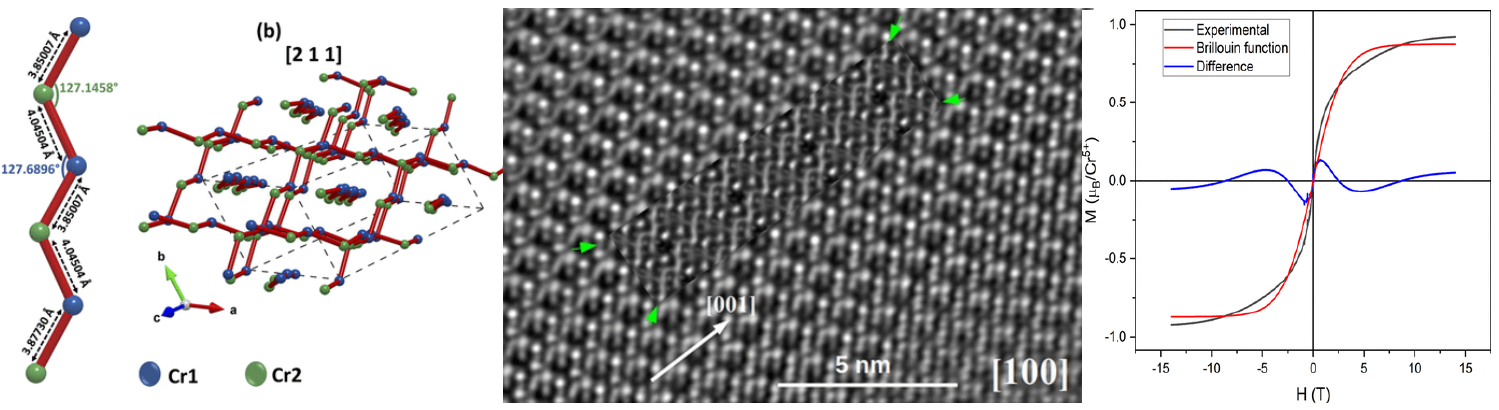
Coexistence of Two Spin Frustration Pathways in the Quantum Spin Liquid Ca10Cr7O28

Kagome antiferromagnetic lattices are of high interest because the geometric frustration is expected to give rise to highly degenerated ground states that may host exotic properties such as quantum spin liquid (QSL). Ca10Cr7O28 has been reported to display all the features expected for a QSL. At present, most of the literature reports on samples synthesized with starting materials ratio CaO/Cr2O3 3:1, which leads to a material with small amounts of CaCrO4 and CaO as secondary phases; this impurity excess affects not only the magnetic properties but also the structural ones. In this work, samples with starting material ratios CaO/Cr2O3 3:1, 2.9:1, 2.85:1, and 2.8:1 have been synthesized and studied by X-ray diffraction with Rietveld refinements, selected area electron diffraction
measurements, high-resolution transmission electron microscopy (HRTEM), low-temperature magnetometry, and magnetic calorimetry. This result shows that a highly pure Ca10Cr7O28 phase is obtained for a CaO/Cr2O3 ratio of 2.85:1 instead of the 3:1 usually reported; the incorrect stoichiometric ratio leads to a larger distortion of the corner-sharing triangular arrangement of magnetic ions Cr+5 with S = 1/2 in the Kagome lattice. In addition, our study reveals that there exists another frustration pathway which is an asymmetric zigzag spin ladder along the directions [211], [12−1], and [1−1−1], in which the Cr−Cr distances are shorter than in the Kagome layers.


D. R. Alshalawi, J. M. Alonso, A. R. Landa-Cánovas, and P. de la Presa, «Coexistence of Two Spin Frustration Pathways in the Quantum Spin Liquid Ca10Cr7O28Inorg. Chem. 61, 16228 (2022).

Publicado en HRTEM, microscopy, nanocharacterization, nanoscience, Publications, transition metal oxides | Comentarios desactivados en Coexistence of Two Spin Frustration Pathways in the Quantum Spin Liquid Ca10Cr7O28

Presentación de la tesis doctoral de Jon Canca Ruiz


Jon Canca Ruiz va a defender su tesis doctoral «Fenómenos de orden-desorden en óxidos con estructura tipo rutilo y su aplicación como soportes en catalizadores heterogéneos» dentro del Programa de Doctorado de Química Aplicada de la Universidad Autónoma de Madrid. El acto tendrá lugar el viernes 26 de marzo de 2021 a las 11:00am en el Salón de Actos del Instituto de Ciencia de Materiales de Madrid, CSIC. El aforo está limitado a 40 personas y se aplicará el protocolo anti COVID-19.

Publicado en microscopy, nanocharacterization, nanoscience, People, Ph.D. thesis, Raman spectroscopy, rutile crystal structure, transition metal oxides | Etiquetado , , , , , , , , , , , , , , , , , , | Comentarios desactivados en Presentación de la tesis doctoral de Jon Canca Ruiz

Growth of out-of-plane standing MoTe2(1−x)Se2x/MoSe2 composite flake films by sol-gel nucleation of MoOy and isothermal closed space telluro-selenization

A. Fernández García, V. Torres-Costa, O. de Melo, F. Agulló-Rueda, G. R. Castro and M. Manso Silvan, “Growth of out-of-plane standing MoTe2(1−x)Se2x/MoSe2 composite flake films by sol-gel nucleation of MoOy and isothermal closed space telluro-selenization,” Appl. Surf. Sci. 546, 149076 (2021)

Publicado en nanocharacterization, nanoscience, nanotechnology, Publications, Raman spectroscopy, semiconductor | Etiquetado , , , | Comentarios desactivados en Growth of out-of-plane standing MoTe2(1−x)Se2x/MoSe2 composite flake films by sol-gel nucleation of MoOy and isothermal closed space telluro-selenization

Fabrication and characterization of nanostructured porous silicon-silver composite layers by cyclic deposition: dip-coating vs spin-coating

N. Naveas, M. Manso-Silván, R. Pulido, F. Agulló-Rueda, V. Torres-Costa, T. Plaza, H. Pesenti, G. Recio, and J. Hernandez-Montelongo, “Fabrication and characterization of nanostructured porous silicon-silver composite layers by cyclic deposition: dip-coating vs spin-coating,“ Nanotechnol. 31, 365704 (2020)

Publicado en microscopy, nanocharacterization, nanoscience, nanotechnology, Publications, Raman spectroscopy, silicon | Etiquetado , , , | Comentarios desactivados en Fabrication and characterization of nanostructured porous silicon-silver composite layers by cyclic deposition: dip-coating vs spin-coating

Laser writing of nanostructured silicon arrays for the SERS detection of biomolecules with inhibited oxidation

P. Pellacani, V. Torres-Costa, F. Agulló-Rueda, R. Vanna, C. Morasso, M. Manso Silván, “Laser writing of nanostructured silicon arrays for the SERS detection of biomolecules with inhibited oxidation,” Colloids Surf. B 174, 174–180 (2019)

Publicado en laser irradiation, microscopy, nanocharacterization, nanoscience, nanotechnology, Publications, Raman spectroscopy, silicon | Etiquetado , , , , , , , , | Comentarios desactivados en Laser writing of nanostructured silicon arrays for the SERS detection of biomolecules with inhibited oxidation

Nanostructural changes upon substitutional Al doping in ZnO sputtered films

A. R. Landa-Cánovas, J. Santiso, F. Agulló-Rueda, P. Herrero, E. Navarrete-Astorga, E. Ochoa-Martínez, J. R. Ramos-Barrado, and M. Gabás, “Nanostructural changes upon substitutional Al doping in ZnO sputtered films,” Ceram. Int. 45, 6319–6327 (2019).

Al:ZnO layers, with low and high Al content, 0.2% and 2.1% cat. respectively, have been prepared using the RF magnetron sputtering technique. Noticeable differences in the optical and electrical properties have been detected in these films. With doping, the resistivity decreases and the band-gap increases. The alterations in the films crystalline structure are explained in terms of the nanostructural changes induced by Al substitutional doping, such as a higher concentration of edge dislocation defects and a higher rotation of crystalline nanodomains in the plane of the films (normal to the preferential orientation c-axis) for the high content Al:ZnO layer. A complete description of such effects has been accomplished using several characterization techniques, such as X-ray diffraction, Raman spectroscopy and transmission electron microscopy. The combination of these techniques provides an exhaustive understanding of the films nanostructure.

Publicado en HRTEM, microscopy, nanocharacterization, nanoscience, Publications, Raman spectroscopy, transparent conductive oxides, zinc oxide | Etiquetado , , , , , , , , | Comentarios desactivados en Nanostructural changes upon substitutional Al doping in ZnO sputtered films

Laser writing of nanostructured silicon arrays for the SERS detection of biomolecules with inhibited oxidation

P. Pellacani, V. Torres-Costa, F. Agulló-Rueda, R. Vanna, C. Morasso, M. Manso Silván, “Laser writing of nanostructured silicon arrays for the SERS detection of biomolecules with inhibited oxidation,” Colloids Surf., B, accepted (2018).

The present work reports the processing of laser irradiated Si arrays (LISi) and underlines their surface enhanced Raman scattering (SERS) functionality. A nanostructured Si/SiOx surface forms providing additional fluidic and photoprotective properties. Because of their optical and surface characteristics, the arrays exhibit a SERS analytical enhancing factor of 500, without any noble metals such as gold or silver. Micro-Raman maps allowed studying LISi properties, identifying maximum amplification in nanostructured areas characterized by the presence of 7 nm Si nanocrystals. These structures are confined by a SiOx layer as illustrated by XPS valence band measurements. The highly hydrophilic LISi areas allow a pre-concentration of target molecules prior to SERS analysis. A relevant application of LISi was found in the detection of apomorphine (APO), a drug used for the treatment of Parkinson’s disease. In contrast with what is obtained by using gold SERS substrates, LISi allows the detection of APO with no sign of oxidation. This invites for the use of the Si/SiOx SERS detection in future systems for the personalized delivery of APO.

Publicado en microscopy, nanocharacterization, nanoscience, nanotechnology, Publications, Raman spectroscopy, silicon | Etiquetado , , , , , , | Comentarios desactivados en Laser writing of nanostructured silicon arrays for the SERS detection of biomolecules with inhibited oxidation

Lattice damage in 9-MeV-carbon irradiated diamond and its recovery after annealing

DiamondCarbon20170421.resizedF. Agulló-Rueda, N. Gordillo, M. D. Ynsa, A. Maira, J. Cañas, and M. A. Ramos, “Lattice damage in 9-MeV-carbon irradiated diamond and its recovery after annealing,” Carbon , accepted (2017).

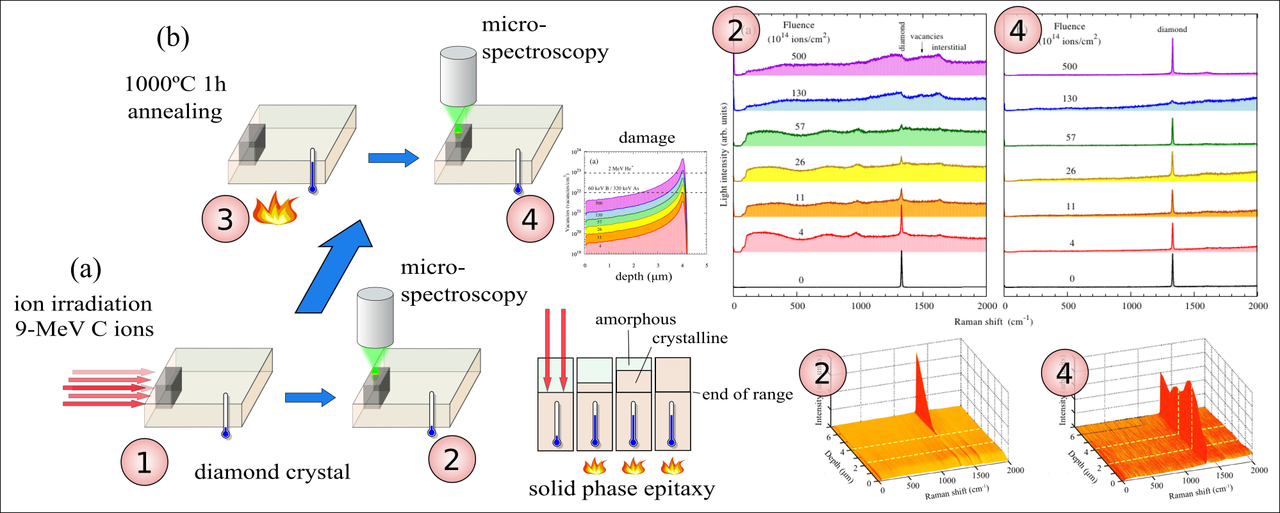
We have studied the radiation damage in diamond as a function of layer depth upon self-ion implantation with 9-MeV carbon ions and its recovery after annealing at 1000°C. Raman and photoluminescence spectra show substantial damage of the lattice, namely, amorphization, neutral vacancies, and interstitial defects. Damage is maximum in the stopping layer at a depth of 4 μm. After annealing there is some recovery of the lattice, but the residual damage increases with fluence, up to about 2 × 1016 ions/cm2. At this fluence the stopping layer becomes highly disordered and does not heal with annealing. Surprisingly, for higher fluence values, of about 5 × 1016 ions/cm2, there is almost no residual damage. After full amorphization is reached, the layers appear to recrystallize by solid phase epitaxy (SPE), using the pristine diamond layers underneath as a template. These results prove that graphitization of diamond after annealing can be avoided in deeply buried layers, implanted at fluences much higher than expected. High fluences, in fact, can lead to high quality diamond layers. If SPE can be confirmed, it would have a great interest for diamond device applications, as it allows for higher doping levels.

Publicado en diamond, ion irradiation, microscopy, nanocharacterization, photoluminescence, Publications, Raman spectroscopy | Etiquetado , , , , , , | Comentarios desactivados en Lattice damage in 9-MeV-carbon irradiated diamond and its recovery after annealing